







His parents were lawyers, but Baba Akomolafe’s mother soon realised that he was more inclined towards science than legal studies.
“I am not sure exactly what she saw, but she encouraged me to take up science. I briefly considered architecture, but my mathematics was not strong enough. She then suggested that I look into health sciences,” he recalled.
However, Akomolafe was not keen on pursuing medicine. “When I saw how many years it takes to become a doctor, I knew that was not for me. Pharmacy, however, appealed to me because of its diversity,” he added.
He also recognised the entrepreneurial opportunities it offered and decided to pursue it.
Though he was born in England, he completed his studies in Nigeria. After graduating from the University of Lagos, he returned to England to complete a conversion course.
He undertook his pre-registration training at a hospital pharmacy and later worked his way up to becoming a self-employed locum. Akomolafe then ran a dispensary and eventually became an outpatient pharmacy manager, a role he held for two years.
However, he had always aspired to be an entrepreneur and finally took the plunge in 2003. He bought a community pharmacy, despite having little idea of what he was getting into. He soon realised that running a community pharmacy was very different from working in an outpatient pharmacy, where he had spent most of his early career.
His only experience in community pharmacy had been a two-week stint during his pre-registration days.
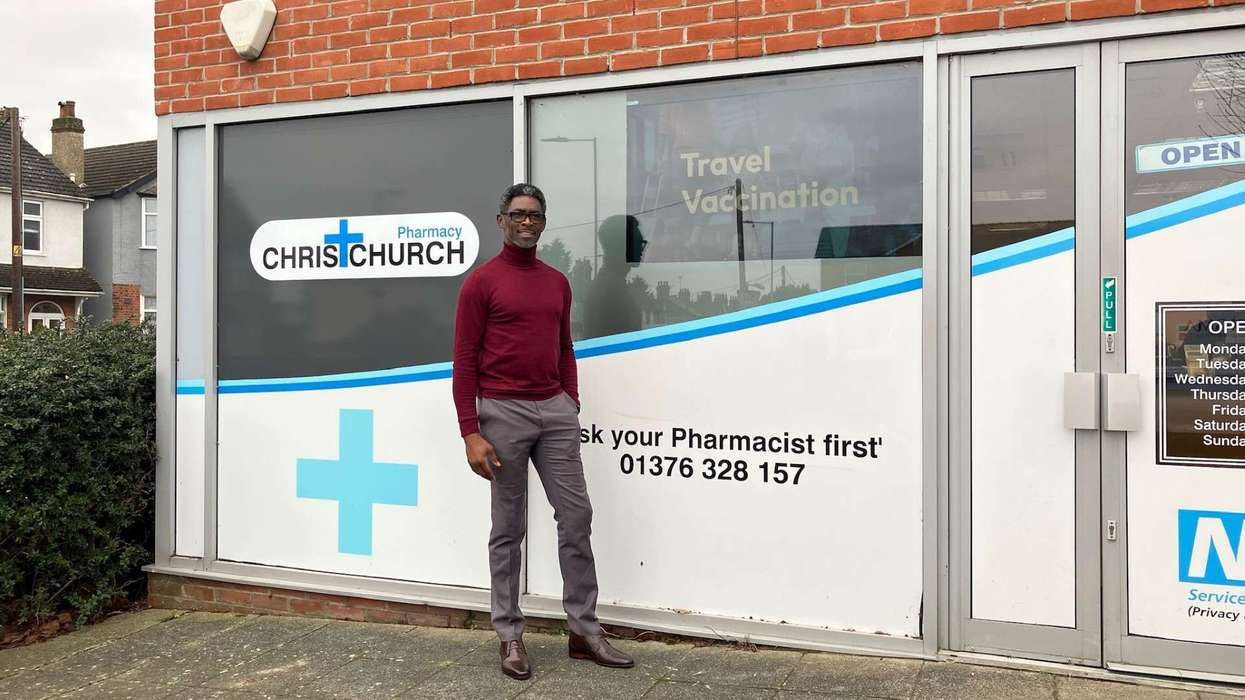
Now, more than 22 years later, his Christchurch Pharmacy and Clinics in Braintree, Essex, stands as a testament to his entrepreneurial journey. From a no-frills pharmacy, it has evolved into a full-fledged health centre.
When asked whether he was inspired by anyone, he said, “I would say that I am inspired by the positive work others are doing. However, I do not compare myself with anyone.
“I focus on being my personal best. Often, people tell me that I have achieved a lot, but I am not always aware of it until someone points it out. At every stage, my goal - both individually and as a team - has been to do our best.”
Robotics and automation
From early on, Akomolafe was fascinated by technology. He is regarded as one of the early adopters of robotic dispensing; Christchurch installed one in 2008.
When asked about this decision, he said, “Well, my wife (Dupe, a doctor) would describe it as laziness. I call it efficiency. There’s a phrase I always use when we’re doing chores: There must be an easier way. For me, that means finding a more efficient way of doing things.”
Akomolafe believes efficiency is no longer optional but essential for survival. “The funding for pharmacy now does not allow anyone who is inefficient to stay afloat. Not just pharmacy—any business. If you're not efficient, your profits will suffer,” he said.
Reflecting on his experience with automation, he added, “Initially, I was seeking an easier way of doing things. A few years down the line, I realised it was critical for survival. That’s why Christchurch has been able to withstand very difficult circumstances.”
After nearly 15 years of using the robot, his supplier approached him in 2021 to upgrade the system, as support for the older version would be discontinued. While they expected to schedule the upgrade months later, Akomolafe surprised them by asking them to begin the following week.
At the time, England - and much of the world - was under Covid-19 lockdowns and travel restrictions, and his pharmacy was shut. “When the upgrade happened, the premises were empty- it was only my staff. That meant we didn’t have to worry about disrupting patients,” he said.
He credits the upgrade for significantly improving efficiency. The robot is now four times more efficient, maintenance costs have dropped, and 90 per cent of repairs can be carried out remotely.
Christchurch has also added a second robot head. “We can now do 75 per cent more than before,” he said.
“As I said, it’s about trying to beat our personal best all the time. We look at what we have, what we need to grow, compete, and make a difference in the community. That’s been the journey.”
Change management
When asked how he brings his team on board with change, he emphasised the importance of mindset.
“You can change your model or your mission, but if you don’t change the mindset, it won’t work. Before introducing anything new, I try to build the team’s understanding so they appreciate why change is necessary—and what happens if we don’t act.”
He believes this helps people see the benefits and prepares them mentally. “Then we introduce what we’re trying to do and how it will work, helping them see and buy into the vision.”
Even then, the team is supported throughout the transition, with potential challenges clearly communicated. “So that on day one, they don’t panic if something goes wrong—they expect it.”
Akomolafe cautions that change management is not easy. “People don’t just need information; they need inspiration. They are comfortable with the present, and you’re asking them to embrace something unfamiliar.”
While they may recognise the potential for improvement, fear of the unknown remains, he added.
Expanding services
As Christchurch operates as a health centre, the team seeks to channel NHS patients towards its private clinic, run by Akomolafe’s wife, Dupe. By interacting with NHS patients, they identify services people are willing to pay for and direct them accordingly.
“But we don’t decide what patients want. We find out what they want and then build a clinic service - led by my wife - to meet those expectations,” he said.
Christchurch already offers services such as earwax removal, a travel clinic, and cryotherapy. He plans to expand further in response to patient demand. “People are asking about allergy tests - we will find ways to connect and provide those services.”
He believes the future of Christchurch will depend on responding to patient needs and delivering tailored services. Weight management is already a major offering. “We will do anything our patients want, as long as we have the competencies,” he said.
He also noted that Christchurch is CQC-registered, allowing it to offer services beyond those permitted under standard pharmacy regulation.
Hub and spoke
Akomolafe believes the hub-and-spoke model is promising but needs refinement. While many are taking a wait-and-watch approach, he expects it to gain wider acceptance.
“If I didn’t have a robot or the software to provide services efficiently, I would have adopted hub and spoke. It allows you to leverage other companies’ technological investments to reduce workload and free up capacity,” he said.
He pointed out that some companies can dispense prescriptions at very low cost, while others on the high street still rely on manual processes. “In that case, NHS income will never be sufficient, especially with rising costs such as staff expenses,” he said.
He plans to acquire another pharmacy this year, which would act as a spoke to his existing business, supported by the second robot head.
Quest for growth
Akomolafe believes entrepreneurs must often push against the grain to sustain growth. In pharmacy, this requires balancing professional responsibilities with business acumen.
Asked about rising minimum wages and business rates, he said the sector is not being treated fairly. “If the rain is falling on all houses, I don’t mind. But when it’s only my house, it’s unfair. Dentists and GPs receive business rates relief, but pharmacies do not.”
Despite these challenges, he emphasised the need to adapt and continue growing.
Outreach programmes
Christchurch also runs outreach and awareness initiatives, managed by Akomolafe’s son, who joined the business last year after completing his studies in digital media and communications. He now oversees community engagement, both offline and online.
Last Christmas, they organised a community health event offering blood pressure checks and support for elderly and disabled individuals.
“We are building partnerships with retirement communities and planning initiatives such as ‘knit and natter’ sessions, where older people can socialise while engaging with our team,” he said.
Akomolafe also acknowledged the support of the local council, which partners with them on outreach activities, including job fairs, awareness events, and staff wellbeing programmes.
His younger son is studying IT and plans to join the business after completing his studies, helping to expand Christchurch’s digital healthcare capabilities.
Advice to pharmacists
For aspiring pharmacists, Akomolafe advises understanding one’s strengths.
“If you enjoy working with people, pharmacy is a good choice. If you prefer structured environments, hospital pharmacy may suit you better. Community pharmacy offers a balance between healthcare and entrepreneurship,” he said.
He emphasised that the profession is evolving, particularly with prescribing roles and expanded clinical responsibilities. “Rather than choosing a profession based solely on its current reputation, choose one with strong growth potential. Pharmacy offers many new opportunities.”
He added that while change can be challenging, it also brings recognition and advancement.
“I have been in pharmacy since 1994, but in areas such as prescribing, newer graduates may have an advantage because they are trained from the outset. They are fresh and ready to take on new opportunities,” he said.