



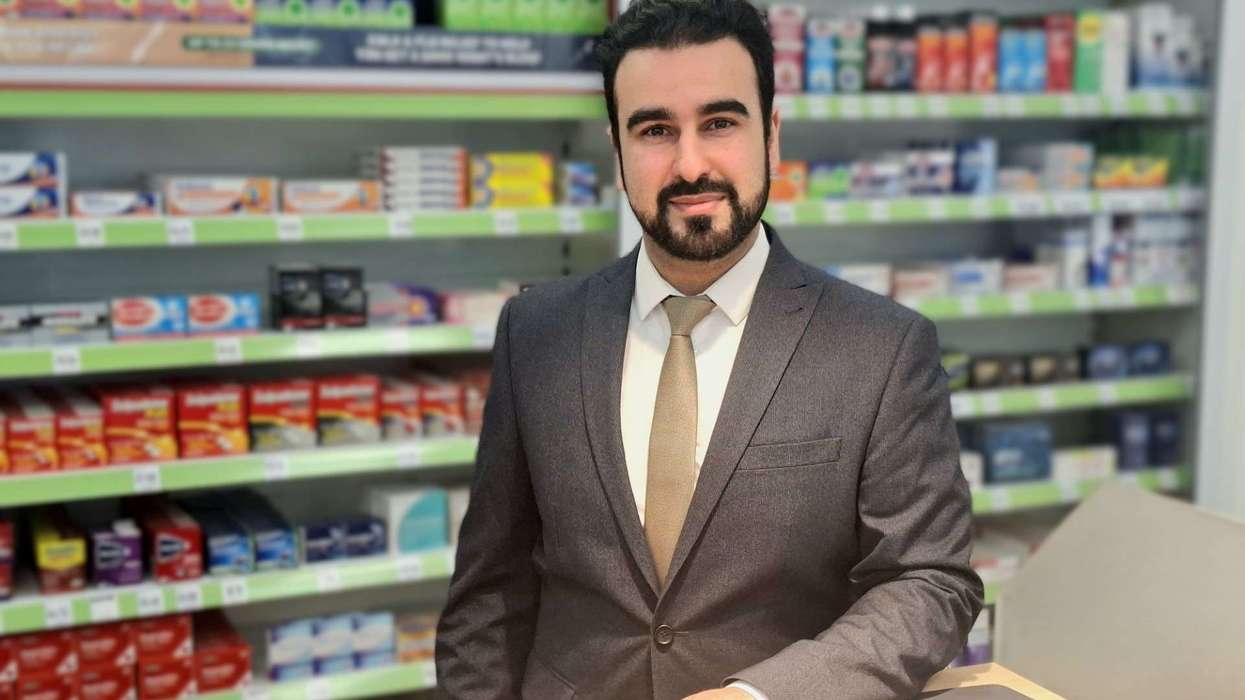

Coming from a family of electricians and electrical engineers, Yasser Abboud is a first-generation pharmacist. He says the turning point came when he was 12 years old and his uncle fell ill. A team of doctors and pharmacists came together to treat him.
Abboud was impressed by the way the two teams collaborated to ensure they made the best decision for a man “whom they did not know and had never met before.” They had a patient in front of them and were trying to help him lead a normal life again, he added.
Abboud was closely involved in the incident, as he had taken on the role of a translator. He said he found it challenging because of the many technical terms involved, and he feared he might have translated things incorrectly to his family members.
But what struck him most was the personal touch shown by the pharmacy team and the way they spoke to both his uncle and him.
“It wasn't just ‘this is the cholesterol level and this is the blood pressure.’ They wanted to know how the patient was getting along, and they also checked on me, as I was young,” he said.
Abboud was not initially aware of who they were, but later his parents told him they were pharmacists. He says his love for the profession began around that time.
During his high school and college years, pharmacy was always at the back of his mind. He studied maths, biology, and chemistry, as he felt these subjects would be useful for pursuing a pharmacy education.
Pharmacy as a career
In 2014, Abboud joined Reading University for the pharmacy programme and qualified in 2019. He feels he has been very fortunate with the opportunities that came his way during the early part of his career.
He also credits several pharmacists who mentored him during this period for shaping his career. After completing his studies, he secured an opportunity to do his pre-registration at Lloyds Pharmacy. There, he supported cluster managers, participated in audits, and did “anything I could to improve patient safety.”
He then followed a natural progression into a management role, joining Lloyds as a manager. However, Abboud was not satisfied with his tenure, as the company was constantly undergoing restructuring and lacked stability. “You never knew what was going to happen,” he said.
“I initially focused on mastering the clinical fundamentals - accuracy, safety, and patient counselling. But because I started in a management position, I quickly realised that real impact comes from developing strong leadership skills.”
Abboud became passionate about building high-performing teams to improve service delivery and create systems that “make the safest kind of practice sustainable under pressure.”
“My journey has evolved from being a relatively good pharmacist to someone who develops people and drives measurable outcomes, because I take pride in how strong my team is,” he said.
Lansdales stint
Abboud later got an opportunity to work at Lansdale's Pharmacy, an independent pharmacy in High Wycombe with four branches. He joined as a pharmacy manager but was promoted within a few months to group manager, overseeing all branches.
He described this as one of the best things to happen in his career. Abboud worked closely with the owner and gained insights into how the business operates - knowledge that is often difficult to acquire in large corporate settings.
“Working for Lansdales Pharmacy allowed me to see how deals are made and how we maximise gains from the dispensing side, particularly dispensary margins,” he said.
Abboud also credits the owner for giving him the freedom to introduce new services to grow the business. He led the introduction of the COVID vaccination service at Lansdale's Pharmacy, and soon they were administering 1,000 vaccines a week.
He says this experience tested him as a leader and gave him the opportunity to learn more about himself. “As a leader, you want to be on the field, and that's something I've always done,” he added. “When your team sees you doing all of this, they are motivated to do the same.”
This contributed to the rapid growth of Lansdales, and Abboud learned a great deal along the way. He believes the experience he gained there has been a major influence on who he is today.
However, the workload began to take a toll on his family life. He found it difficult to spend time with his son, as he had to travel long distances to work, leaving early and returning late at night. Often, his son would be asleep when he was at home.
Abboud pointed out that his father came from a humble background and worked hard, yet was always present for his children - and he wanted to do the same for his son.
Asda switchover
So, he made the difficult decision to part ways with Lansdale's and joined a branch of Asda closer to home.
As a firm believer in building strong teams, Abboud applied the same principles at Asda. While focusing on accountability, he also ensured that his team members did not experience burnout.
He believes pharmacists are particularly prone to burnout due to long hours and the demanding nature of the profession.
Abboud encourages his team to take initiative and ensures that everyone understands the reasoning behind decisions. He does not believe in chasing numbers to achieve success. Instead, he focuses on structured processes and continuous improvement, so that team members feel a sense of ownership in their achievements.
He credits his team for the success of the services offered at his pharmacy. “I have a fantastic team, and I absolutely could not do what I do without their resilience.”
He emphasised that his pharmacy does not view services merely as a way to improve patient care. “We make sure we look after patients as best as we can, but more importantly, we aim to build a one-to-one connection with them.”
It is no secret that community pharmacists are often more accessible than other healthcare professionals. As a result, they are frequently the first point of contact for patients, he added.
Abboud acknowledges that pharmacies are currently going through a challenging period, but is encouraged by the growing public awareness of the issue.
Promoting services
At Asda, the focus remains on what they can control, including service delivery. However, he notes that this requires careful planning.
“I cannot wake up tomorrow and say I'm going to do a thousand flu jabs,” he said. “This requires planning, ensuring your team is on board, and engaging patients.”
He believes patient education is often neglected and that more can be done to raise awareness about the services pharmacies offer.
“There are still people today who come to the pharmacy and say they did not realise that pharmacies offer so many services,” he said.
While pharmacies do conduct marketing campaigns, Abboud believes nothing is more effective than one-to-one interaction with patients.
He actively encourages this approach and notes that patient engagement has been highly effective in increasing service uptake. “We don't try to convince them to come to us - we just let them know we are here if they need us.”
Citing flu vaccinations as an example, he said many people are unaware that pharmacies can provide flu jabs and instead queue at GP surgeries. Persuading them was initially difficult, he added.
Gradually, more patients began coming in. At Asda, this turned into a team-building exercise, sparking friendly competition among staff about how many people they could protect in a day.
“If you ask me about a moment I am most proud of in my journey, it would be seeing my team create that friendly competition,” he said.
“It was not about how many jabs we could administer, but how many people we could protect,” he emphasised.
Patients coming in for vaccinations were also informed about other services offered. “It's about letting people know we're here - and often they respond positively.”
Abboud ensures that patients are made aware of all available services. When they experience the standard of care provided, they often enquire about and use other services when needed.
He explained that services at Asda are tailored to the specific needs of each region, taking into account the population profile and economic conditions. Services are first trialled, and if successful, staff are trained to implement them effectively.
Abboud also conducts one-to-one meetings with team members to ensure they understand new services and can address any concerns.
Technology adoption
He supports the use of technology but believes it should align with the pharmacy’s needs. While his current pharmacy does not have a dispensing robot, he has previous experience with one at Lansdales and was impressed by its performance. He hopes Asda will adopt similar technology in the future.
Asda has, however, implemented PMR systems to enhance safety. “There are additional steps now to ensure that medicine boxes are scanned before the pharmacist conducts the final check. Everything is designed to promote the safest possible practice for patients,” he said.
Abboud expressed concern about reports of pharmacy closures. “Every time a community pharmacy closes, that's one less access point for patients. In areas already underserved, closures can place significant pressure on patient safety.”
When asked what advice he would give to aspiring pharmacists, he said his success is built on four pillars: systems, culture, data awareness, and leadership visibility.
“Refine workflows so that service volume never compromises safety. That should always be the core principle. Growth must never come at the expense of safety.
“When it comes to culture, create an environment where high standards are expected and non-negotiable. Patients should receive the same level of care every time they visit.
“Data awareness means monitoring performance - whether you own a business or work for someone else. Stay on top of your data and view targets as the minimum benchmark, not the maximum.”
On leadership visibility, he added: “It is crucial that leadership is visible on the shop floor - not hidden in an office. Both your team and your patients should see it.”
Reflecting on his own approach, he said: “I make it a habit to be present at the counter, engaging with patients. I've worked hard to reach a point where people call me by my name rather than ‘pharmacist,’ and I value that. It builds trust.”
He concluded: “Focus on those four pillars, wherever you are. That’s probably the best advice I can give to young pharmacists.”
For students still in college, Abboud emphasised the importance of developing leadership skills early. “Clinical competence is essential, but great leadership multiplies your impact. Protect your standards - because excellence is a habit,” he said.