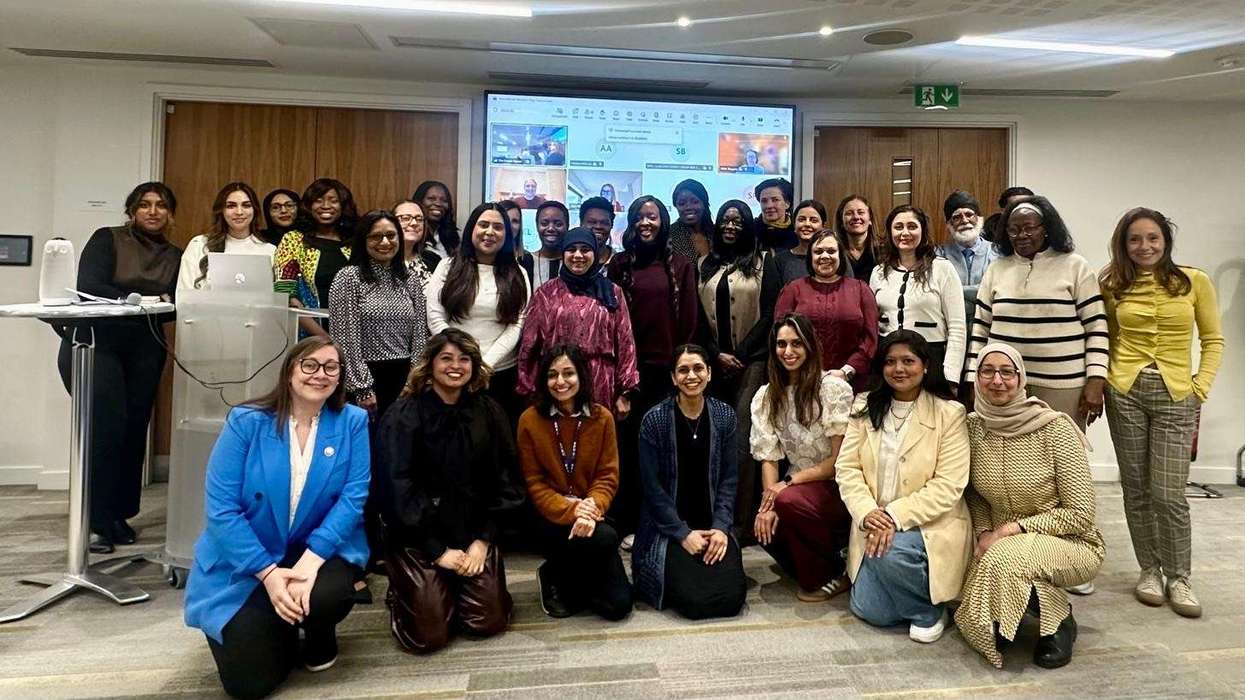







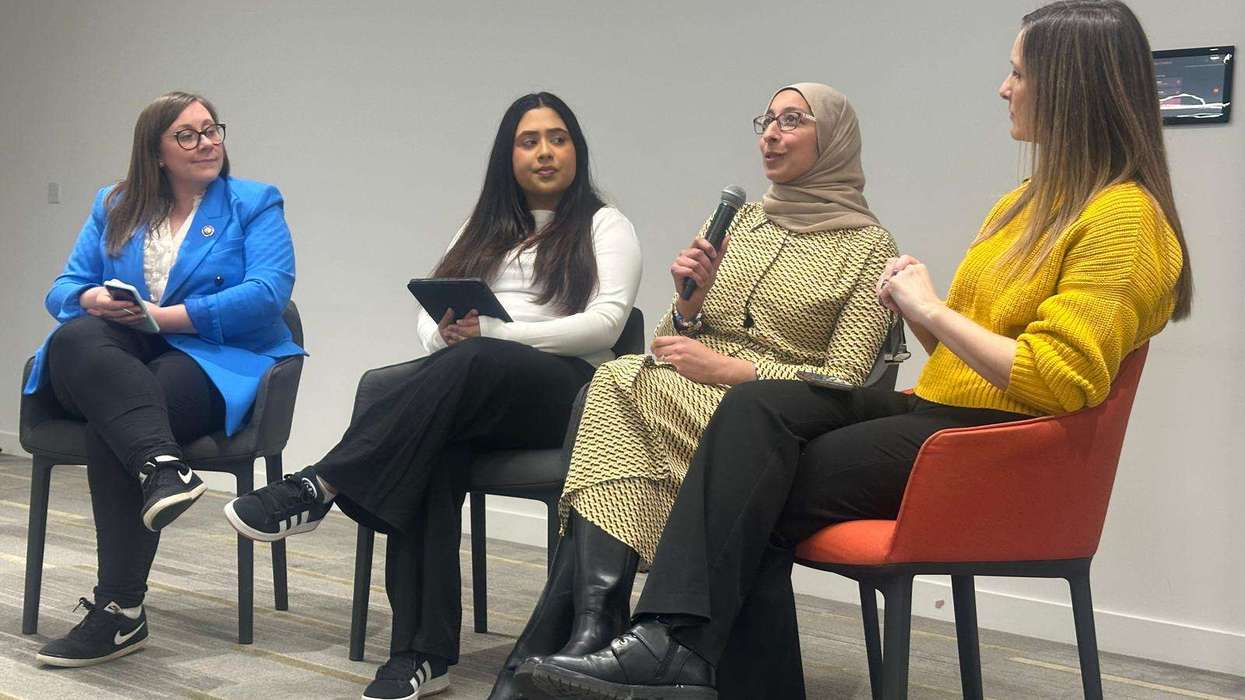
The Royal Pharmaceutical Society (RPS) hosted a hybrid event in connection with International Women’s Day on Thursday (26) with “Give to Gain” as this year’s theme.
The event was divided into an interactive workshop and panel discussion; which took place virtually as well as offline at the Royal Pharmaceutical Society, London, and was open for both members and non-members.
The event was held in association with Pharmacy Business, Association of Pharmacy Technicians UK (APTUK), British Pharmaceutical Students Association (BPSA), Guild of Healthcare Pharmacists (GHP), Female Pharmacy Leaders Network (FPLN), Pharmacy Technicians of Colour (PToC), and UK Black Pharmacist Association (UKBPA).
A space for the women who dream, plan and achieve
“Give to Gain” began with the Workshop: Vision Boards for Ambition and Impact.
RPS director for England, Amandeep Doll, welcomed the participants, which was followed by conversations filled with real-life inspiring stories, struggles, and dreams of passionate health professionals spanning from pharmacists to scientists, inspired the attendees.
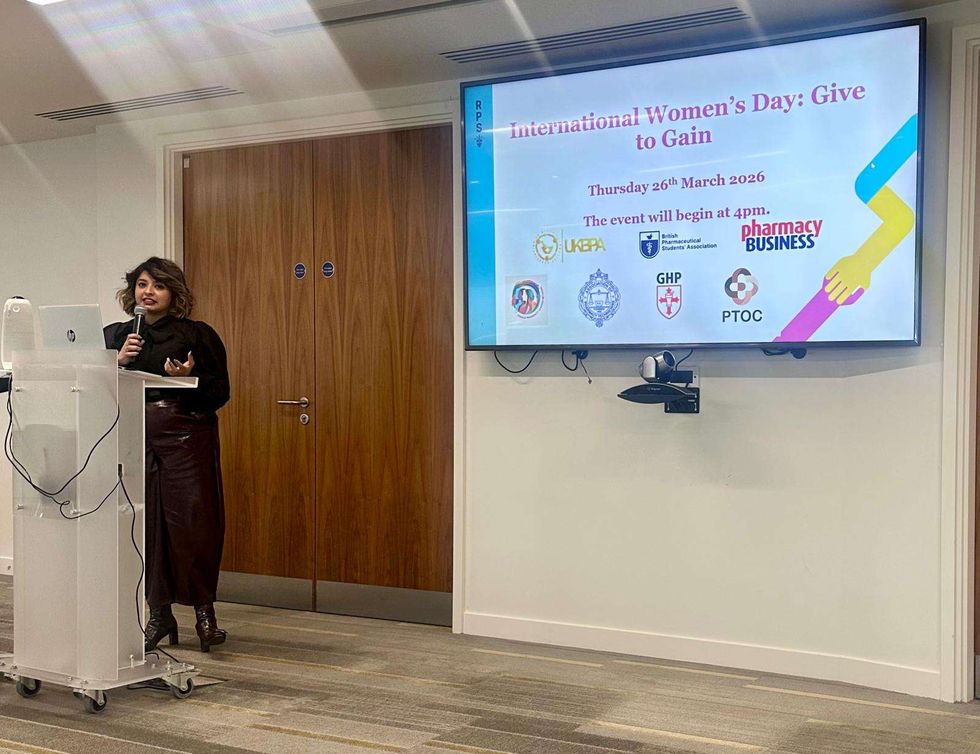 RPS director for England, Amandeep Doll, welcoming the participantsMonica Bernal-Quiroz/Pharmacy Business
They initially discussed what they are currently working on that excites them, which received a bunch of interesting answers reflecting tireless efforts to chase dreams. These included inspirational stories and milestones including setting up a pharmacy school, their organization’s 10th anniversary, and the success of recent ISCE training sessions.
While some are on their way to set up a pharmacy school, some are celebrating a decade of their career, while others are attending training programmes to upskill, some testing strategies to revolutionise the pharmacy sector and many more.
This was followed by the topic how they spend their energy in a typical week, a question that showcased the multitasking ability of pharmacists as well as a moment that questioned the idea of work-life balance.
This showed that being a pharmacist required sacrifices, including personal time, family quality time, etc.
The European Institute for Gender Equality’s recent study reveals that 32 per cent of women regularly struggle to balance work with childcare.
Some of the participants spoke about their mom guilt of not being able to be around their little ones, and shared the stories of waiting families and their inability to slow down in life.
“We don't give ourselves enough credit for how much we juggle on the day-to-day when you've got family or caregiving responsibilities and work and all of the other things that come with just having busy lives,” commented Sarah Baig, pharmacy professional lead for The Black Country Training Hub and Regional Pharmacy Ambassador at RPS.
The next activity aimed at goal-setting that emphasised on small goals or small habits.
They shared their achievements and goals in professional development, personal development, relationships and health.
The ideas flowed from reconnecting with spirituality and family to even small wins like restarting reading habit, exercises like simple walking, spending less time on social media, etc.
“I am amazed by people, I'm amazed by women every single day, all the women around me,” said Rachael Black towards the end of the session.
She added, “I'm really grateful for all the pharmacists that I know, including my local one, that has helped me numerous times when I've had issues with my little babies, and that kind of thing, so you are all absolutely smashing your careers, and your family life.”
The one-hour-long workshop concluded on a reflective and empowering note, bringing life to idea of “Give to Gain” through meaningful and uplifting female pharmacist voices cheering for each other.
Benefits of sponsorship
“To Give to Gain is all about us reflecting on ourselves, reflecting on what we've achieved, elevating ourselves so other people can help us. The panel is about how can we help others help us, and that always starts with us recognising what we have done, what we can contribute, who we are as women,” said Abundance Temile, vice president of the UK Black Pharmacist Association.
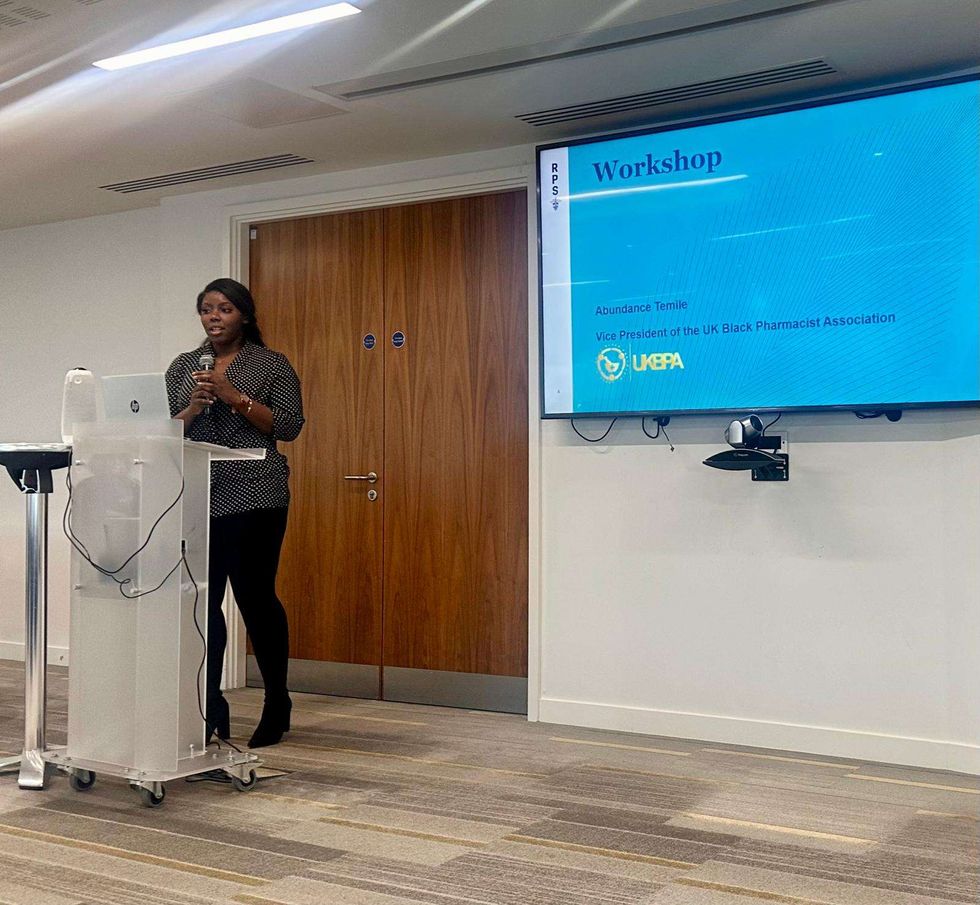 Abundance Temile, vice president of the UK Black Pharmacist Association, addressing the audience at the eventMonica Bernal-Quiroz/Pharmacy Business
The panel discussion was moderated by Samantha Quaye, co-founder of Pharmacy Technicians of Colour and Head of School (Pharmacy) at NHS England.
“I think it's really important to recognise that I wouldn't be where I am today, both professionally and personally, without a whole host of sponsors within my life,” said Amy Laflin, president of Association of Pharmacy Technicians UK (APTUK).
She adds that sponsors are not only just about those that have developed us in our careers, but extends to friendships and family, who stood by us.
“Being an introvert, my confidence had to grow significantly, very quickly and overnight. So ‘Give to Gain’ is not just a theme for me. It's about being part of a cycle. When we give opportunities to others, we gain a stronger, more inclusive profession.”
Hadeel Mohamed, deputy head of Clinical Pharmacy & Education Lead for SEL GP Group and founder of ENIGMA Mentoring Initiative and Network said that she has gained a lot and said she is now feels more confident about speaking nationally about Enigma, which she would never have done before.
She added, “But then I completely recognise that that's not me. I know it's me and everybody else behind me, because Enigma wouldn't work without all the people volunteering their time.”
Inclusivity and ‘invisible barriers’
Research carried out by the PDA and Equality Trust found women earned less than men in nearly every role including pharmacist, pharmacist manager and general practice pharmacist. The only role in which women earned more on average was relief pharmacist and that was marginally 0.5 per cent higher.
Laflin said there are invisible barriers also within the field. “And that could be imposter syndrome, unequal opportunities and the pressure to do absolutely everything ourselves. And those challenges are real and they can feel really heavy,” she added.
“And so specifically within APTUK, we have the barriers of being a pharmacy technician in practice, but also predominantly we are a white female led organisation. And we do have things that we're doing to be able to implement and change that.”
She highlights the tendency for women to “minimise” achievements.
“I have just become the Director of England, I am a powerlifting champion, and they're not small things, but we're so good at minimising everything,” said Laflin. She added that it takes effort to say you have done something amazing.
Mentorship and community initiatives
“I don't necessarily sort of see people like myself in positions of power or positions of leadership. So if you are a woman of colour or just a woman in general and you are in that leadership position, give advice to students, guide them, give advice to anyone around you, you know, your colleagues and sort of share your experiences, the challenges as well as the successes,” said Samiha Amin, External Relations Officer 2025/26, British Pharmaceutical Students’ Association and 3rd year student at University of East Anglia.
She also highlighted the quality of approachability among mentors.
When asked about what advice would you share to students, Amin mentioned the benefits of connecting with people via LinkedIn.
She also added the importance of putting yourself in uncomfortable situations.
“I think taking that first step can be difficult, especially when you see a big group of people, or whether it be like a conference or webinar, it can be quite nerve-wracking, but if you have an opinion, say it, there's probably someone there with the same opinion as you,” she added.
She also wishes she had heard about the BPSA and the RBS earlier on and that while in college, many are unaware of such opportunities.
“I think for me I wish someone had sponsored me earlier. When I reflect back it really bothers me. Because I was really obvious with my ambition and desire to do something constantly putting myself forward,” reflected Mohamed.
Samantha adds that this next generation are just so much more aware.
“I think your point is really well-made as well because, again, there are connections between interacting on online platforms—using these days, LinkedIn is kind of the place of choice at the moment where people are going. And actually, that does flatten hierarchy. So don't be afraid to reach out to people. Don't be afraid to connect even though you've only seen that person from across the room tonight. Just do it, because I think that is how you kind of build your networks as well,” Mohamed adds.
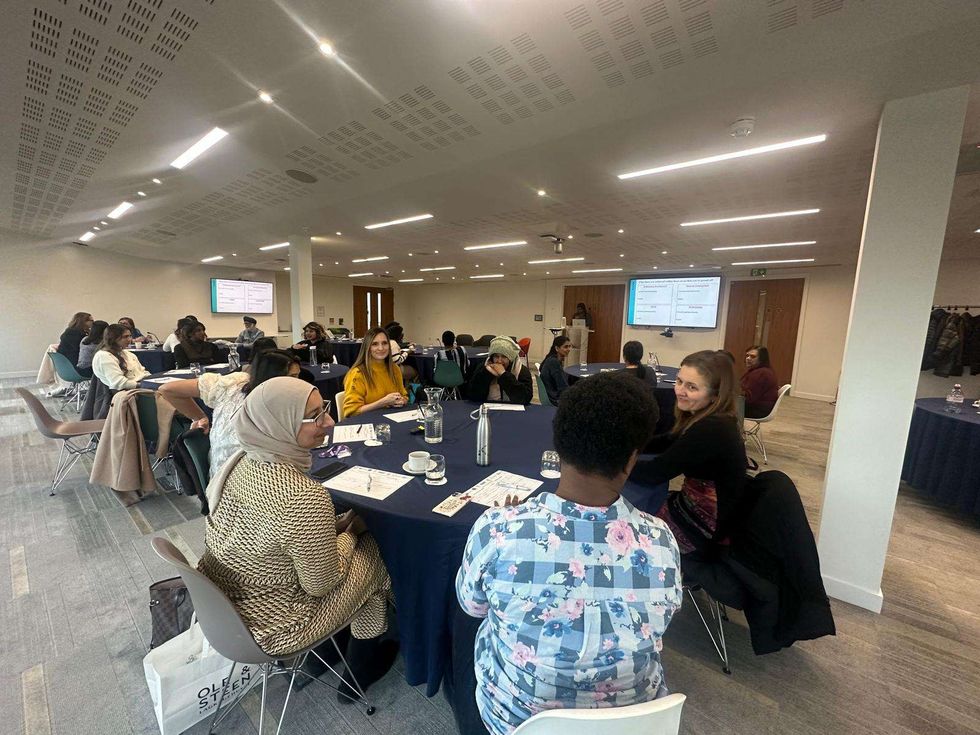 The participants engaged in insightful conversations Monica Bernal-Quiroz/Pharmacy Business
Women in leadership roles
According to GPhC’s register as of March 2025, about 62 percent of pharmacists and 84.2 percent of pharmacy technicians with a registered address in England identify as female.
Despite representing the majority of pharmacists in the UK, only 2 percent of women are pharmacy business owners compared with 13 percent of men. Also, the majority of senior pharmacy leadership positions are held by men, with research showing that only 36 percent of senior pharmacy leaders are women.
“And I would really like to hope that APTUK can further become a more inclusive space, not just for our female pharmacy technicians, but for the wider pharmacy technician community as well. And when we give support to those climbing behind us to be able to really progress themselves, we gain a future where women don't just participate, but they actually are enabled to lead,” she added.
When we gain to give, our voice is to advocate for equality and then we gain a culture where every woman feels valued, Laflin said.
An ongoing cycle
The discussion concluded with a powerful reminder that "giving to gain" is a continuous cycle. As Samantha Quaye noted, the future of the profession depends on those currently in leadership "putting the ladder back down" for those climbing behind them. By recognising their own contributions and advocating for one another, the panelists agreed that women in pharmacy can move from mere participation to authentic, enabled leadership. The final consensus was a call to action for all attendees: stop minimising achievements, find your "glimmers" every day, and never be afraid to ask the "silly" questions that move the profession forward.