





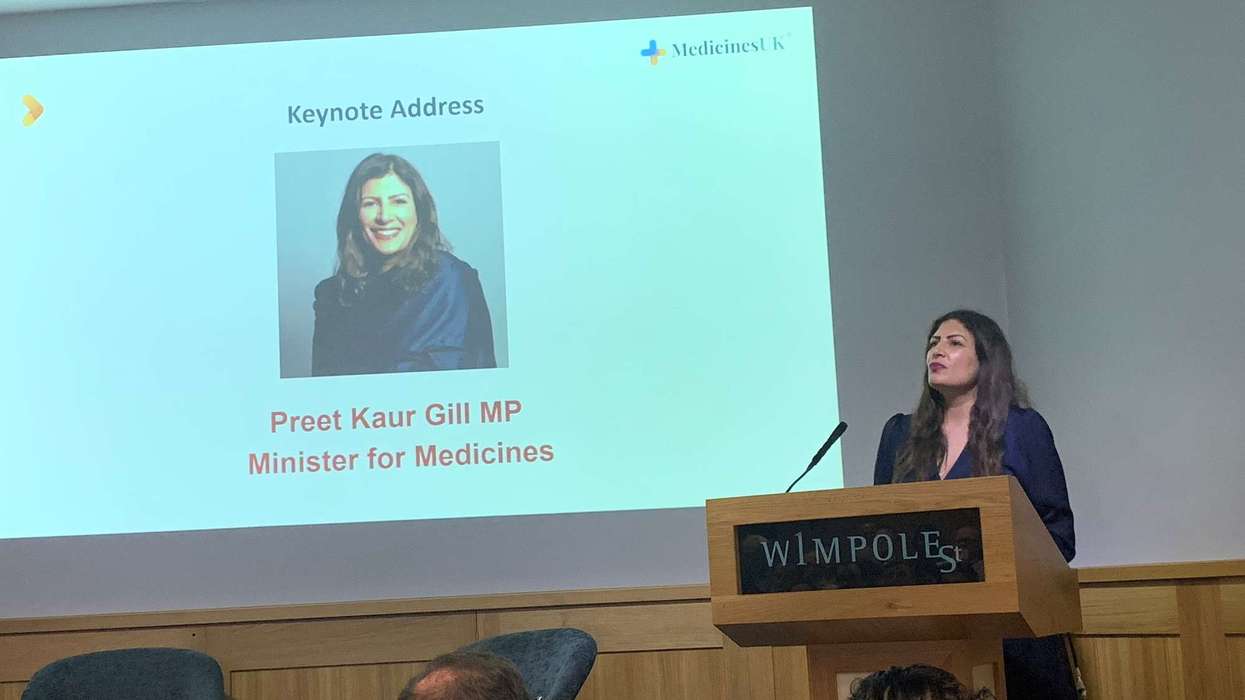

Resilience in medicines supply, innovation in medicines development, and attracting new product launches to the country, are key priorities for the UK government — achieved through effective collaboration with medicines manufacturers — the minister for medicines, Preet Kaur Gill MP has told the sector.
Speaking at the annual conference of Medicines UK in London on Tuesday (14), the minister said the UK has “one of the most competitive and resilient updated medicines markets anywhere in the world,” she said, but that this hadn’t “happened by accident”. Close working with medicines manufacturers is of central importance to government.
“We now live in a world where medicine supply is about far more than logistics,” said the minister. Resilience is no longer “simply an operational challenge”, she warned, “it is actually a national security issue”.
Global conflict and disruption to international trade routes, as well as the potential for future pandemics, are continued threats to medicines manufacture and supply.
International collaboration
The minister said that the recent partnership between the UK’s Medicines and Healthcare products Regulatory Agency (MHRA) and India’s regulator, the CDSCO, was a good example that “resilience extends beyond our own borders”.
“India is one of the world's leading manufacturers of medicines, and it's long been a trusted partner of the United Kingdom. And during the pandemic, that relationship proved its value.
“And today, through closer collaboration between the MHRA and India's Central Drug Standard Control Organization, we are building on that foundation to strengthen regulatory cooperation, support high standards, and improve the resilience of global medicine supply. And that partnership reminds us that resilience was not built in isolation; it was built from trusted international relationships.
“Britain must remain an outward-looking life science nation, working with international partners while continuing to strengthen our own manufacturing capability here at home,” she said.
Preet Kaur Gill was recently appointed parliamentary under-secretary of state for health innovation and safety and has been the MP for Birmingham Edgbaston since 2017. She was the first female British Sikh member of parliament.
Also speaking at the Medicines UK conference, Lawrence Tallon, MHRA chief executive, agreed that international collaboration will help to position the UK as a more attractive regulatory environment.
“A couple of weeks ago we announced a new status between ourselves and the FDA, where we will have a liaison office in the FDA in Washington, and they will have a liaison office with us in London. This puts us in a different position in terms of that transatlantic route. So, design; approve in the UK; go to market in the US.
“The other crucial single country jurisdiction is India, because if we look at where the volume is, where the growth is going to be in the decades ahead — not just now, but in the decades ahead — and we look at commonalities of things like language and legal frameworks, we really want to have that same situation with India, whereby we can say that there is regulatory and recognition of reciprocity between our countries,” he said.
“For a country the size of the UK, we have a scientific base and regulatory science that boxes well above its weight, but we're only 68 million people, so it's unlikely that product developments were designed for the UK market alone, he added.
The minister said that there was a vision for the MHRA “to be recognised not simply as one of the world's safest regulators, but as one of the world's most agile and innovation-friendly-friendly regulators, without ever compromising on patient safety”.
Innovation and access
The minister said she wanted Britain “to be the best place in the world to discover medicines; to develop them; to manufacture them and ensure patients can benefit from them once patents expire”.
The off-patent medicine sector had an important role to play, she reassured.
“Generic medicines, biosimilars, and value-added added medicines widen patient access, support the NHS quality equity, and ensure every pound we invest delivers the greatest possible value for patients,” she said.
“I know that innovation does not stop where exclusivity ends. In many ways, that is where innovation delivers its greatest impact,” she added.
“Too often, the off-patent medicine sector is linked simply through the lens of procurement and affordability. I think that misses the bigger picture.
“Innovation does not end when a patent expires. The millions of NHS patients, that is when innovation truly begins. It begins when high-quality generic medicines become available, when biosimilars widen access to life-changing treatments, and when value-added medicines improve the way care is delivered, and when every patient wherever they live can benefit from safe, effective, and affordable medicines.”
We are entering “one of the most exciting periods in the history of medicine,” she said.
“Artificial intelligence is accelerating drug discovery and transforming how clinical trials are designed. Genomics is enabling increasingly personalised treatments. Advanced manufacturing is changing how medicines are produced, and digital technologies are helping us identify the right treatment for the right patient at the right time.”
Impact of off-patent medicines sector
Paul Burden, UK Country Head at Accord Healthcare and chair of Medicines UK, stressed the importance to the NHS of working in partnership with government.
"Without the savings, the value, and access that our sector delivers, the ability to meet the needs of a growing and ageing population simply would not exist. The UK's competitive off-patent market, underpinned by freedom of pricing, remains one of the great success stories of the health system," he said.
"We need to continue to make the case clearly and consistently that the right medicines, used in the right way, reduce pressure elsewhere in the system. They keep people out of hospital, they support productivity, and above all, they improve lives.
"As an industry, we should be extremely proud of the role that we play and confident in making a case for investment, for sustainability, and growth in the future. What we do truly matters, and we must never allow complacency to creep into the future of life sciences or healthcare policy development, and for the sector to be sidelined or ignored. Recent conflicts show that supply chain resilience has never been more important."
Community pharmacy funding
When asked to comment on funding for the community pharmacy sector during questions, the medicines minister said that the recent Community Pharmacy Contractual Framework was the best deal possible at the time from the government, but that she recognises the situation.
“I know it's challenging; I hear this from pharmacies all the time. I know you know the margins are very, very difficult, and pharmacists are spending a lot of their time on this.
“But we've gone as far as we possibly could in the spending review in terms of the announcement we made.”