







Seasonal skin deterioration is one of the most underrated presentations seen at the pharmacy counter between November and March. Much of the time it is dealt with at the counter with minimal clinical input.
But there is a science to management of skin during the winter seasons. Here we review the mechanisms and clinical physiology behind changes in the skin barrier during winter.
The wall
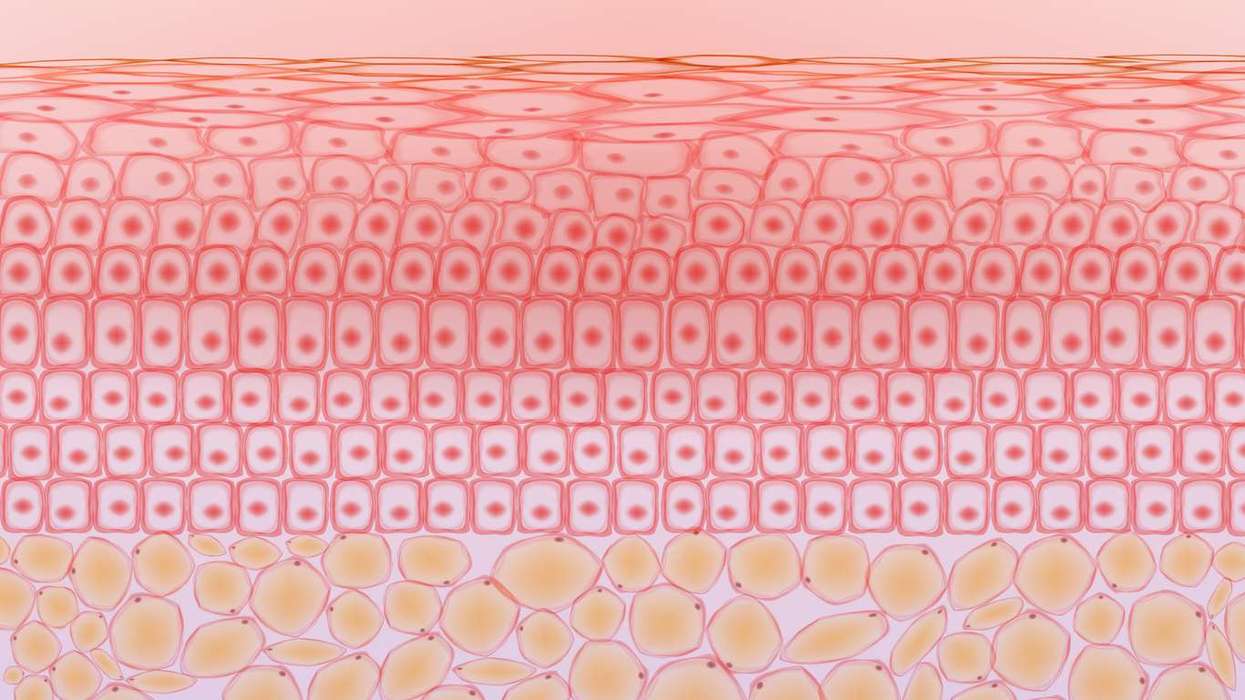
The stratum corneum is the outermost layer of the skin. It holds water in and keeps irritants out, and it needs moisture in the air to do that well.
Picture a brick wall. The bricks are corneocytes which are flattened, dead skin cells packed with keratin. The mortar is a lipid matrix between them, made mostly of ceramides, cholesterol and free fatty acids. Ceramides are the main waterproofing component. The lipid matrix is stacked into ordered sheets, and how tightly those sheets pack is what decides whether water gets through. Skin can have enough lipid, poorly arranged, and still leak.
Keeping water inside the bricks is a separate job, done by natural moisturising factor, or NMF: a mixture of small water-attracting molecules, such as amino acids, PCA, lactate and urea. These molecules inside the corneocytes and draws water in, rather like a sponge. NMF is not applied from outside. The skin makes it by breaking down filaggrin, a structural protein in the upper epidermis. Filaggrin is also the protein that is faulty in people carrying loss-of-function mutations in the FLG gene, the strongest known genetic risk factor for atopic eczema.¹ They make less NMF, which is much of why their skin is dry to begin with.
Why winter is a problem
Winter degrades both systems at once. Stratum corneum lipids, ceramides especially, are markedly depleted in winter compared with spring and summer.² Mainly because filaggrin breakdown depends on the humidity and temperature around the skin, NMF can decrease too, studies have shown measured levels are lower on the cheek in winter than in summer.³
Less mortar between the bricks, and less sponge inside them reduces the ability to retain moisture.
During the winter, cold air holds less moisture and central heating can make this worse because warming cold air without adding water to it lowers the relative humidity, so indoor air in January is often drier than the air outside. Wind strips the thin humidified layer that normally sits above the skin and hot water with repeated surfactant washing, e.g. the detergents in soaps and shower gels; removes lipids faster than lukewarm water does.
The people who feel it first are those already compromised: eczema and psoriasis patients, older adults with declining sebaceous activity, babies, and anyone doing continuous wet work, for example chefs, hairdressers and pharmacy staff.
What can be done to support winter skin erosion?
It is a layered approach:
Stop the stripping
The cheapest intervention, and the one most patients forget. Lukewarm water rather than hot, shorter showers and swap shower gel and hand soap for an emollient used as a soap substitute. This stops the daily lipid removal. For those working outside gloves for wet work and for cold, windy days.
Rebuild the mortar
Step the vehicle up as dryness worsens, using lotions, creams or ointments. Ointments hold occlusion longest and suit very dry skin and overnight use, though they can cause folliculitis if overused.⁴ Quantity is where most regimens fail: guidance suggests up to around 500g a week for adults and older children with generalised eczema, half that for younger children.⁵ Most people do not use enough.
One question to ask a patient is how much emollient have your used rather than which one did you use? The appropriate way to apply an emollient is to smooth it on in the direction of hair growth rather than rubbing it in, and apply while the skin is still slightly damp.
Treat the inflammation already there
If there is an eczematous flare up emollients will not settle an active flare alone. Where a topical steroid is indicated, check it is being used properly and continued for around 48 hours after the flare settles.⁷
One safety point to note is: Emollients transfer onto clothing and bedding and can act as an accelerant. The MHRA's 2018 warning covers all paraffin-containing emollients regardless of concentration and says the risk cannot be excluded for paraffin-free products either.⁶
Refer on for eczema not responding to optimised treatment, weeping or crusting suggesting infection, suspected eczema herpeticum, and any new, changing or asymmetric lesion that does not fit ordinary dryness.
Winter xerosis is a common ailment during the winter season but it can be treated effectively within the community pharmacy.
Dr Yasmin Karsan is a pharmacist, independent prescriber.
This article is the second in a series of three looking at the management of the skin in winter. Look out for: Winter skin and melasma: how to protect and care for skin and Eczema and psoriasis in winter.
References
- Kezic S et al. Levels of filaggrin degradation products are influenced by both filaggrin genotype and atopic dermatitis severity. https://www.ncbi.nlm.nih.gov/pmc/articles/PMC3586662/
- Rogers J et al. Stratum corneum lipids: the effect of ageing and the seasons. Arch Dermatol Res 1996. https://pubmed.ncbi.nlm.nih.gov/8950457/
- Engebretsen KA et al. Changes in filaggrin degradation products and corneocyte surface texture by season. Br J Dermatol 2018. https://doi.org/10.1111/bjd.16150
- PrescQIPP / NHS emollient prescribing guidance. https://www.prescqipp.info/media/1306/b76-emollien...
- National Eczema Society. Emollient prescribing for eczema. https://www.eczema.org.uk/wp-content/uploads/Emoll...
- MHRA. Emollients: risk of severe and fatal burns with paraffin-containing and paraffin-free emollients. Drug Safety Update, December 2018. https://www.gov.uk/drug-safety-update/emollients