






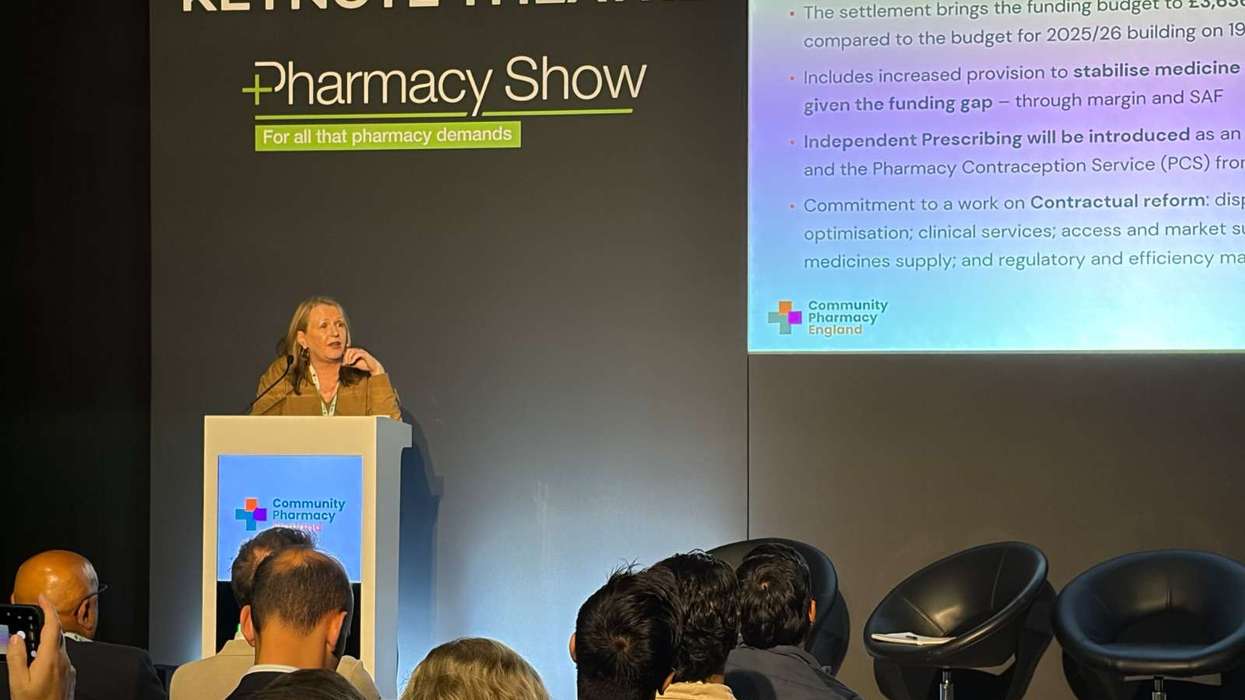

Community Pharmacy England (CPE) is advising contractors to "think very carefully" before signing up to deliver the new prescribing Pharmacy First clinical pathways, its chief executive Janet Morrison has said.
Speaking at the Pharmacy Show on 11 Oct, Morrison reiterated that CPE had "really serious concerns" that the money put into the contractual framework for the new pathways was not sufficient to reflect the governance, insurance and workload involved.
Contractors should "really understand their increased clinical responsibilities, the insurance and governance involved before signing up," she said.
She also pointed out that "currently only 20% of community pharmacies have an independent prescriber" on their team and urged contractors to consider ways of bringing prescribers into their pharmacies.
Morrison described independent prescribing as "a strategically important development of the sector" and she noted that while the government was "absolutely committed" to introducing it as a manifesto pledge, she said CPE needed to make sure funding for it "is going to continue to grow" in future years.
Funding gap remains
Morrison said the 10.3% uplift agreed in this year's contractual framework was a step forward, but that around 9% was needed just to cover rising activity and inflation.
She said part of the reason for the uplift was ministers' concerns "about the safety and stability of medicine supply", with extra funding directed into margin as a result.
Pressures on the sector remain "very serious", she added. The independent economic review showed "how underpaid we are", by at least around £2 billion for the work pharmacies already do.
"Many pharmacies are saying, actually, you know, we're losing money, not making money," she said, warning that this affects not only whether pharmacies stay open but also the quality of service.
Contract reform
Morrison said CPE has begun scoping contractual reform with the Department of Health and Social Care and NHS England. The work covers dispensing and medicines optimisation, clinical services, access and market sustainability, margin and medicines supply, and regulatory and efficiency matters.
Many of the short-term measures being considered first draw on proposals CPE made in previous negotiations. Longer-term issues will require extensive evaluation and analysis, she said.
She indicated the reform work could pause when contract negotiations start, which are scheduled to begin this autumn, resuming once those talks conclude.
New ministers, muted ambitions
Morrison said CPE had "definitely picked up [a] change of flavour" since Wes Streeting left the Department of Health and Social Care. Prime Minister Andy Burnham appointed Yvette Cooper as health secretary in July.
It is "still early days", she said, and the new team has not yet defined what it wants from primary care or community pharmacy. The 10-year health plan is still mentioned, but "very much more muted" than under Mr Streeting.
She highlighted Mr Burnham's commitment to social care, which she said would be large demand on government budgets. She added that Cooper had set out her priorities as child health, maternity standards and health inequalities.
With the government facing tight finances and tough choices, Morrison warned that "we may be holding our breath for a while" before the plan's ambitions are realised.
She also said the government's emphasis on devolution and local accountability poses challenges, with community pharmacy not yet fully enabled to take part in neighbourhood health and "ICBs are in some chaos".
Pharmacy First a 'stepping stone'
Morrison said Pharmacy First was "an important stepping stone". It has delivered over 14 million consultations since launch, including urgent medicines supply and minor illness referrals, with 3.4 million Pharmacy First consultations last year.
The service is largely driven by sore throat and uncomplicated urinary tract infections, she said. This achievement had been despite "pretty low level" national marketing of the services, and said that more publicity could drive more valuable health interventions.
Pharmacist prescribers who join the new pathway will be able to treat additional conditions approved by NHS England, prescribe in place of patient group directions in Pharmacy First and the contraception service, and in some circumstances issue replacement prescriptions. By comparison, she noted that Pharmacy First in Scotland covers around 27 conditions.
But she cautioned against simply asking for more services. "Rather than add up lots and lots of additional slivers of services, we need to still make sure that the government is getting the [most] out of the investment they've already made," she said.
What the sector needs
Looking ahead, Morrison said there was scope for community pharmacies to do more in vaccination, screening, medicines optimisation and deprescribing, building on the New Medicine Service and the Discharge Medicines Service.
She called for a more joined-up approach to primary care investment. "We should not be in competition with GPs for resources," she said.
She also raised concerns about pharmacy's place in NHS digital plans. Despite heavy investment in the NHS's digital future, "there's been very little conversation in community pharmacy about what that means for us", she said.
Asked whether CPE was pushing for a nationally funded deprescribing service, Morrison said CPE had held discussions on existing adherence services and on clinical services as part of longer-term reform. However, she said the priority was making sure current services deliver the benefits they could.