






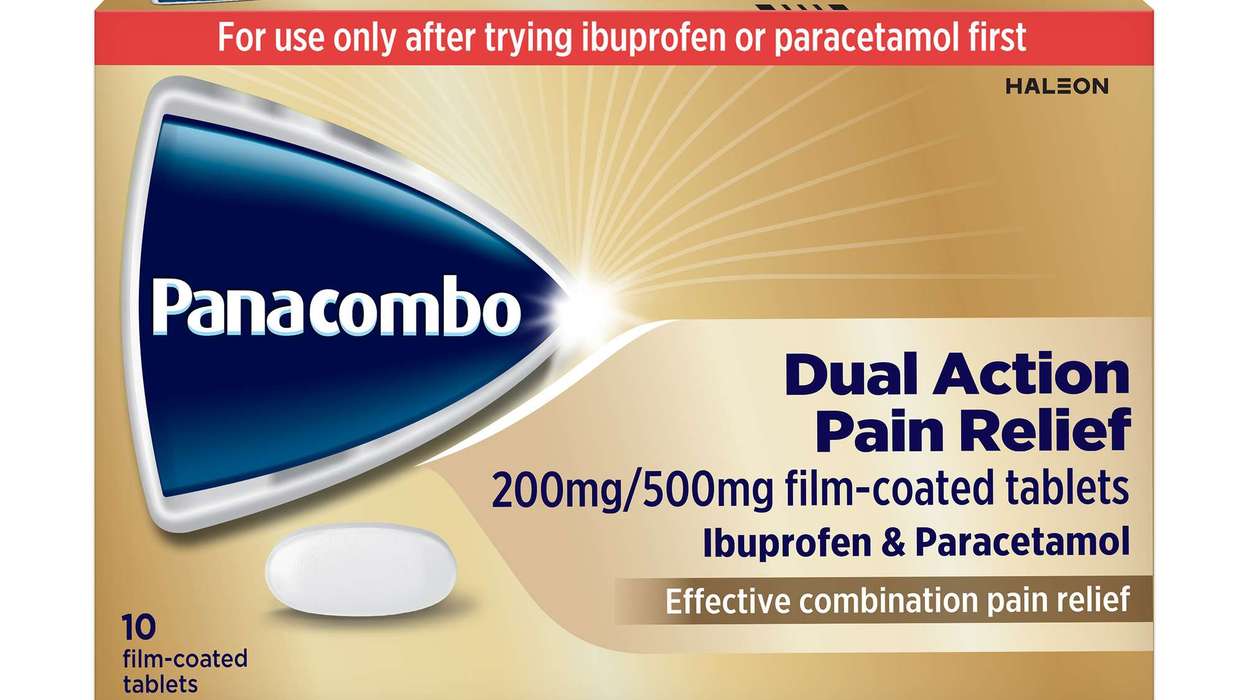

Haleon, the makers of Panadol, has expanded into the dual action pain relief market with the launch of Panacombo Dual Action Pain Relief 200mg/500mg Film-coated Tablets (ibuprofen and paracetamol).
The formulation brings together two pain-relieving ingredients in one tablet to help patients break through pain “when regular painkillers alone aren’t enough”.
Panacombo Dual Action Tablets are stronger and work faster than ibuprofen alone, designed to deliver effective pain relief from multiple pain types including migraine, headache, backache, dental pain, period pain, joint or muscular pain and aches linked with cold and flu.
Ibuprofen acid alone provides effective pain relief in 37-45% of cases, while combining ibuprofen with paracetamol increases effectiveness to 67-70%1a, highlighting the enhanced pain relief achievable through a combined approach.
Panacombo Dual Action Tablets are formulated to give patients dual relief in one tablet. Paracetamol helps to block pain signals, and ibuprofen helps stop pain at the source.
Panacombo starts to get to work in 5 minutes(based on absorption) and provides relief that can last for up to 9 hours, helping to manage pain throughout the day.
For use only after trying ibuprofen or paracetamol first.
Speaking on the launch Michael Durkin, GB Sales Director at Haleon, said: “For 70 years, Panadol have been experts in pain relief, trusted to assist consumers with pain when needed. The launch of Panacombo, our dual-action pain-relief solution, expands our range of trusted products, and will offer retailers a strong proposition to help boost sales, encouraging shoppers to trade up and benefit from our trusted brand credentials.”
Panacombo Dual Action Tablets retail in pharmacies at an RRP of £3.50.
The launch will be supported by a wide-reaching consumer media activation and campaign later in the year.
References
- Effective pain relief rates reported for ibuprofen acid 200mg and 400mg (37% and 45%, respectively), and ibuprofen/paracetamol combinations of 200mg/500mg and 400mg/1000mg (67% and 70%, respectively).
- Moore RA, et. Al;. Non-prescription (OTC) oral analgesics for acute pain - an overview of Cochrane reviews. Cochrane Database of Systematic Reviews 2015, Issue 11.
Product Information
Full information can be found in the Summary of Product Characteristics
Panacombo Dual Action Pain Relief 200 mg/500 mg film-coated tablets (ibuprofen, paracetamol). Indications: For the temporary relief of mild to moderate pain associated with migraine, headache, backache, period pain, dental pain, rheumatic and muscular pain, cold and flu symptoms, sore throat and fever. Especially suitable for pain which requires stronger analgesia than ibuprofen or paracetamol alone.
Dosage: Before taking this medicine, the patient should first try ibuprofen or paracetamol for pain relief as directed for the first day of treatment. If ineffective, this medicine can be taken the next day. Consult a doctor if the symptoms persist or worsen or if the product is required for more than 3 days. Adults: one tablet up to three times a day with water. If one tablet is insufficient to control symptoms, a maximum of two tablets can be taken up to 3 times a day. Leave at least 6 hours between doses. Maximum 6 tablets in 24 hours. Take with food to minimise side effects. Elderly: Due to an increased risk of serious consequences of adverse reactions, if an NSAID is considered necessary, use the lowest effective dose for the shortest time and monitor regularly for gastrointestinal bleeding. Not for use by children under 18 years.
Contraindications: In patients with: known hypersensitivity to active substances or to any of the excipients, a history of hypersensitivity reactions (e.g. bronchospasm, angioedema, asthma, rhinitis, or urticaria) associated with acetylsalicylic acid or other NSAIDs, active, or a history of recurrent peptic ulcer/haemorrhage (two or more distinct episodes of proven ulceration or bleeding), a history of, or an existing gastrointestinal ulceration/perforation or bleeding, including that associated with NSAIDs, defects in coagulation, severe hepatic failure, severe renal failure or severe heart failure (NYHA Class IV). Concomitant use with other NSAID containing products, including cyclo-oxygenase-2 (COX-2) specific inhibitors and doses of acetylsalicylic acid above 75 mg daily and with other paracetamol-containing products. The last trimester of pregnancy due to risk of premature closure of the foetal ductus arteriosus with possible pulmonary hypertension.
Warnings and precautions: The concomitant use with other products containing paracetamol may lead to an overdose. Immediate medical advice should be sought in the event of an overdose, even if the patient feels well. Caution, regarding paracetamol, if used at therapeutic doses for a prolonged period or administered concomitantly with flucloxacillin due to increased risk of high anion gap metabolic acidosis (HAGMA), particularly in patients with severe renal impairment, sepsis, malnutrition and other sources of glutathione deficiency (e.g. chronic alcoholism). If suspected, discontinue use promptly and monitor closely, including measurement of urinary 5-oxoproline. Use with caution in patients with glutathione depleted states, systemic lupus erythematosus (SLE) and mixed connective tissue disease disorders, a history of gastrointestinal disease, with current or a history of bronchial asthma or allergic disease, and in those taking concomitant medications which could increase the risk of ulceration or bleeding. GI bleeding, ulceration and perforation, has been reported with all NSAIDs at any time during treatment, with or without warning symptoms or a previous history of serious GI events. Risk is higher with high doses, in patients with a history of ulcer, particularly if complicated with haemorrhage or perforation, and in the elderly. Consider combination therapy with protective agents, and also for patients requiring concomitant low dose acetylsalicylic acid, or other drugs likely to increase gastrointestinal risk. Patients with a history of GI toxicity should report any unusual abdominal symptoms particularly in the initial stages of treatment. If GI bleeding or ulceration occurs withdraw treatment. Cases of Kounis syndrome have been reported in patients treated with this medicine. Appropriate monitoring and medical advice are required for patients with a history of hypertension and/or mild to moderate congestive heart failure. High dose (2400 mg/day) ibuprofen use may be associated with a small increased risk of arterial thrombotic events. Patients with uncontrolled hypertension, congestive heart failure (NYHA II-III), established ischaemic heart disease, peripheral arterial disease, and/or cerebrovascular disease should only be treated with ibuprofen after careful consideration, avoiding high doses. Exercise careful consideration before initiating long-term treatment for patients with risk factors for cardiovascular events particularly if high doses of ibuprofen are required. Renal tubular acidosis and hypokalaemia may occur following acute overdose and in patients taking ibuprofen products over long periods at high doses (typically greater than 4 weeks), including doses exceeding the recommended daily dose. Monitor renal function in patients with impaired renal function, cardiac impairment, liver dysfunction, those taking diuretics and the elderly due renal failure following from a potential reduction in prostaglandin formation. Severe cutaneous adverse reactions (SCARs), which can be life- threatening or fatal, have been reported in association with the use of ibuprofen, occurring usually in the first month. In the event of signs or symptoms withdraw ibuprofen treatment immediately. Treatment can mask symptoms of infection, monitor if using for fever or pain relief in relation to an infection, and patients should be advised to consult a doctor if symptoms persist or worsen. Not recommended in women attempting to conceive, may impair female fertility by an effect on ovulation. Effect reversible on treatment withdrawal. Consider treatment withdrawal in women who have difficulties conceiving or who are undergoing investigation of infertility.
Side effects: See the SmPC for full details. Common: Abdominal pain, vomiting, diarrhoea, nausea, dyspepsia, abdominal discomfort, hyperhidrosis, alanine aminotransferase increased, gamma-glutamyltransferase increased, liver function tests abnormal with paracetamol. Blood creatinine increased, blood urea increased. Uncommon: Hypersensitivity with urticaria and pruritus, headache, dizziness, peptic ulcer, gastrointestinal perforation or gastrointestinal haemorrhage, melaena, haematemesis, mouth ulceration, exacerbation of colitis and Crohn's disease, gastritis, pancreatitis, flatulence, constipation, various skin rashes, aspartate aminotransferase increased, blood alkaline phosphatase increased, blood creatine phosphokinease increased, blood, creatinine increased, haemoglobin decreased, platelet count increased.
Legal category: GSL
Product licence number: PL 44673/0251.
MAH: Haleon UK Trading Limited, The Heights, Weybridge, Surrey, KT13 0NY, U.K.
RRP (excl VAT): £2.92.
Text prepared: March 2026