






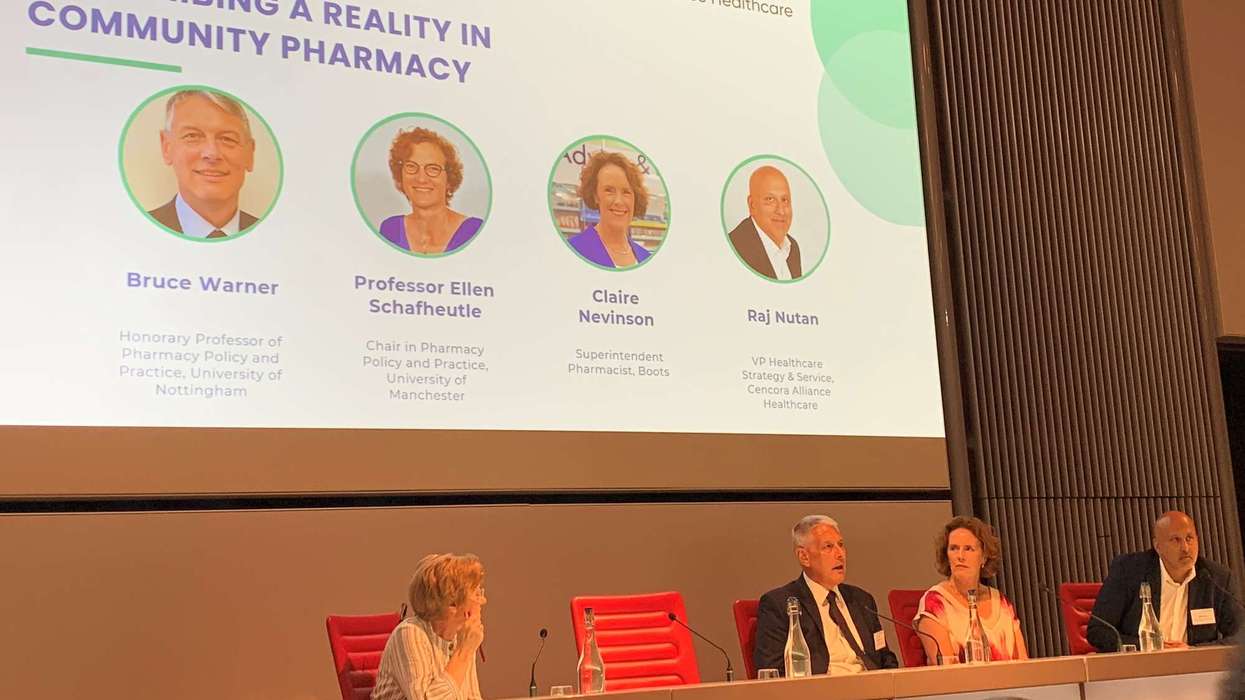

Community pharmacists need effective support and clinical supervision, alongside appropriate funding for independent prescribing to be successful, a panel of speakers told the Company Chemists’ Association policy conference this week (30 June).
Former Deputy Chief Pharmaceutical Officer for England Bruce Warner said he was “delighted” that plans for more widespread prescribing were “coming to fruition”, but commented that “we've got an awful long way to go.”
The profession risks “setting people up to fail” without the mechanisms in place to "allow people to start prescribing with the right support and to give them the confidence and the skills to do that,” said Warner, Honorary Professor of Pharmacy Practice at Nottingham University.
Also speaking on the panel, Claire Nevinson, Superintendent Pharmacist for Boots UK, told delegates that developing prescribing impacts fundamentally on pharmacists as healthcare professionals.
“It’s not just in what pharmacists can do, but for me it's really about how we think about our professional identity, who we are as professionals, is changing, and that's a really good conversation that we need to have,” she said.
Boots was seeing “steady growth” in the number of actively prescribing pharmacists – mostly in Scotland and Wales – and was looking more closely at developing additional digital and in-store prescribing services in England, she said.
Having confidence in the capabilities of pharmacists in the community sector was a vital step forward and “a fundamental shift in the mindset” for the profession, she said.
Expansion of the Pharmacy First services has already “started to help the public understand pharmacy differently,” said Nevinson, another factor for the future success of pharmacist prescribing.
Supporting clinical confidence
Developing individuals’ clinical confidence is also a key factor for prescribing pharmacists, she suggested.
In the experience of introducing prescribing practice in Boots pharmacies, “the challenge isn't clinical capability”, she said, but more about practitioners developing full confidence in their own prescribing practice.
“Prescribing requires the pharmacist to think very differently, to use their clinical judgment, to be okay with ambiguity; to work in the grey, and to take a little bit of risk,” she said.
In contrast to working within PGDs, as is common in community pharmacy, prescribing needs an approach that is different to following structured frameworks that “are very black and white”.
With community pharmacist prescribers most often working largely alone, “we need to try and find mechanisms that reduce that sense of isolation and help people to feel supported,” added Warner.
This “will help people be more comfortable with working with risk when working in those grey areas,” he commented.
Funding as the foundation of IP
Panel member Raj Nutan, vice president of healthcare strategy & service at Cencora Alliance Healthcare, said that the success of independent prescribing did need adequate funding at its centre.
“First and foremost, we need to have a strong foundation, and that foundation has to be funded, has to provide a level of funding to sustainable community pharmacy network needs to invest and be confident to invest in independent prescribing now and into the future,” he said.
“We need confidence to invest, and that will only come from sustainable and the right level of funding. Once you put that funding by that foundation, there's a number of critical success factors which need to be built on that solid foundation.
Having the right support and infrastructure based on appropriate funding would ensure the sector can consistently meet the high standards necessary for prescribing services, he added.
Relationships with other prescribers
Pharmacist independent prescribing also has the potential to allow pharmacists to work differently with other prescribers, such as GPs, the panel discussed.
Warner said: “We've spoken a little bit about confidence of pharmacists in providing the service, but we do also need to provide confidence to both patients and our other health professional colleagues.”
He added: “I think one of the really exciting things about pharmacist prescribing is that actually it allows you to close that episode of care.
“It's very frustrating for pharmacists to know exactly what the patient needs but not be in a position to provide that.”
Currently, not being able to follow through on the care of a patient, can be the cause of tensions in primary care with other healthcare professionals, who then need to follow up with that patient, he suggested.
Rather than a single episode of care, as currently delivered by Pharmacy First, the expansion of pharmacist-independent prescribing offers wider ongoing management of patients by pharmacists, he suggested.
He said a “really exciting” opportunity for pharmacist prescribing was in the management of long-term conditions.
“The management of that long-term condition not only allows the pharmacist to potentially close the episode of care but certainly maintain that, without generating more work for somebody else.
“Actually taking the workload off other people, I think provides certain advantages all through the system,” he said.
He added: “I think will facilitate much more communication between pharmacists and GPs, and a much greater sense of shared care of that patient between pharmacists and general practice.”
Professor Ellen Schafheutle, chair in Pharmacy Policy and Practice at the University of Manchester, was unable to join the panel.
The CCA conference was chaired by Dame Barbara Hakin, and NHS England chair Dr Penny Dash made the keynote presentation.
She spoke about the opportunity to further develop capacity in primary care and deliver diagnostic services closer to where they are needed, as we mark a year from the publication of the 10 Year Plan.