






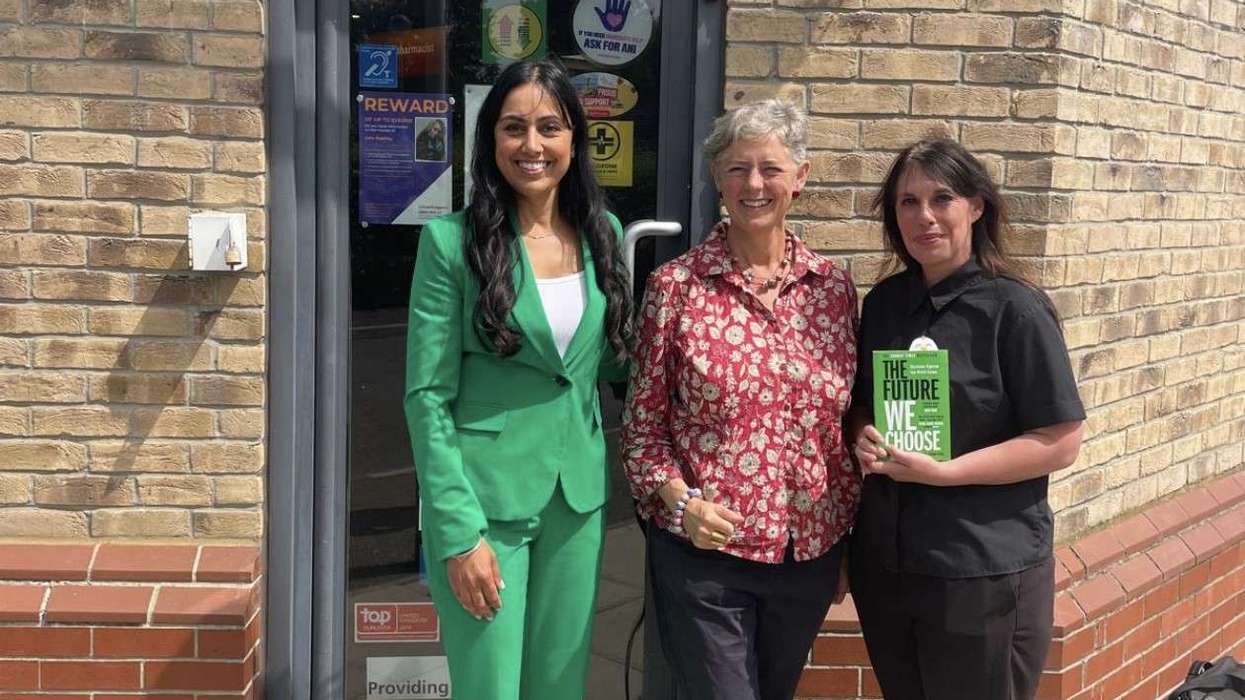

For 2025 Pharmacy Business Sustainable Pharmacy of the Year award winner Jasvinder Kaur Lali, the idea that business and sustainability can go hand in hand came from her two children.
They were always conscious about water usage and waste, and that realisation transformed the way she viewed pharmacy.
"I feel health is directly linked to our environment, what we eat and how we look after our world."
As the co-owner of eight community pharmacies across the Midlands and Cambridgeshire, Lali is a passionate advocate for sustainability, proving that pharmacy can care for both patients and the planet.
Her journey into pharmacy was almost accidental. She once wanted to be a doctor, but realised that the long and demanding road to medicine was not for her.
A friend whose father was a pharmacist introduced her to the profession, sparking an interest that led her to study pharmacy at De Montfort University in Leicester.
"It turned out to be the right career for me," she recalled. "I particularly enjoyed pharmacology."
After completing both her pharmacy degree and master's at De Montfort, Lali undertook her pre-registration training with Moss Pharmacy in Sileby, Leicestershire. She qualified in 2003 and was immediately offered the manager's role at the company's Daventry branch, where she spent the next 18 months.
In 2005, she made a bold decision that would shape her future – becoming a locum pharmacist.
For the next six years, Lali worked across England for companies including Morrisons, Sainsbury's, Boots, Lloyds Pharmacy, Asda and independent pharmacies. Based in Leicester, she regularly travelled to Southampton, Birmingham, Leeds and throughout the Midlands.
The experience, she says, taught her resilience.
"You have to be thick-skinned. You meet different people, different companies and different managers, so I learnt a lot during this period."
Building a business together
 Jasvinder Lali with 2025 Pharmacy Business awardPhoto provided by Jasvinder Lali
By 2011, Lali and her husband, Parminder Singh Lali, who was also working as a locum, felt it was time to build something of their own.
"There was no end goal with locum work," she said. "So we saved some money and decided to open our own pharmacy."
Their first pharmacy opened in Langford in February 2011, followed by a second in Thurston just six months later. While Parminder managed Langford, Lali took charge of Thurston.
The couple quickly became trusted members of both rural communities.
Residents had previously needed to travel around 10 miles to reach the nearest pharmacy. Elderly patients often relied on two bus journeys simply to collect prescriptions or seek health advice.
"They loved having us," Lali said. "People knew they could just come to us for any health advice."
The pharmacies soon became more than healthcare providers – they became community hubs where patients, councillors and local businesses built lasting relationships with the couple.
Balancing family and business
In 2014, Lali stepped away from work after becoming pregnant with her first child and remained focused on raising their young family before returning to work in 2020.
By then, however, the family's business ambitions had grown considerably.
Although the Covid-19 pandemic created uncertainty just as they were considering expansion, the couple soon seized a new opportunity.
In 2021, they acquired four former Lloyds Pharmacy branches in Cambridgeshire, expanding their estate to eight pharmacies.
The move came with considerable financial risk. The former Lloyds branches were struggling, the business had taken on loans, and each pharmacy required investment and new clinical services to become viable.
A greener vision for pharmacy
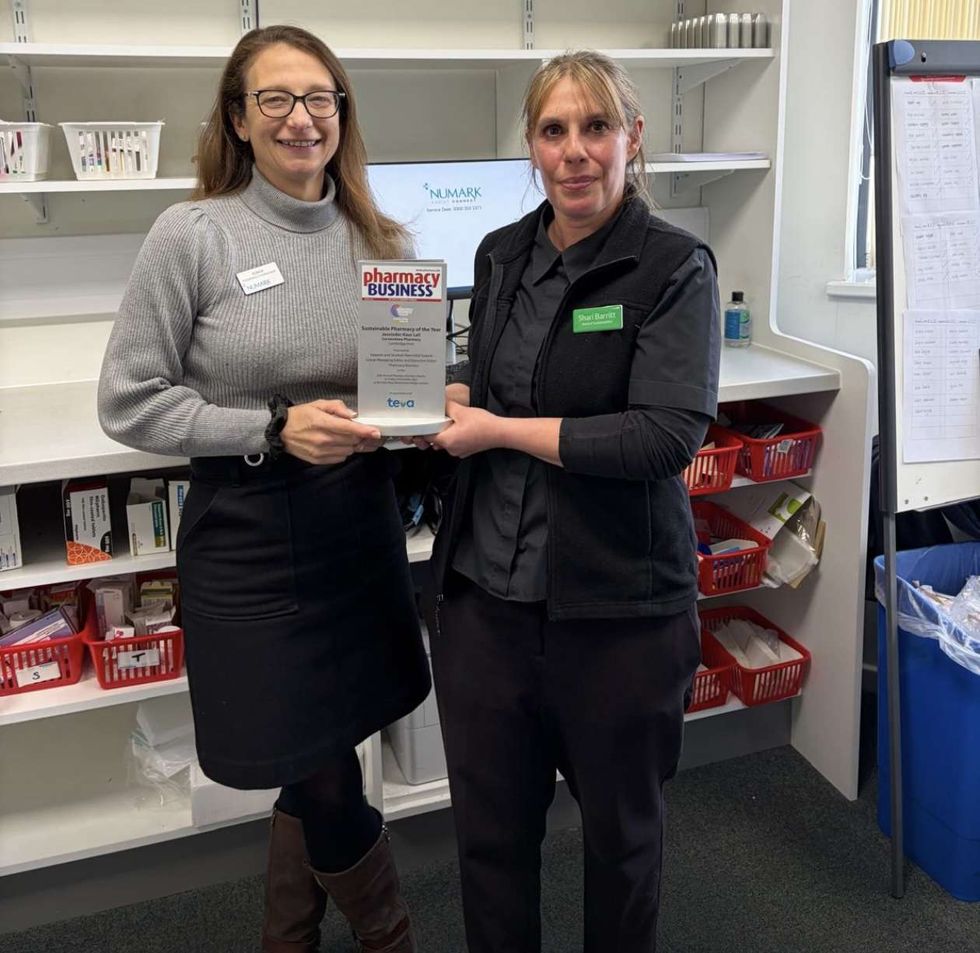 Cornerstone Pharmacy store manager Adele with Shari Braitt.Photo provided by Jasvinder Lali
While rebuilding the business, she also became passionate about sustainability.
But in order to implement it in her pharmacies, she found a willing ally in Shari Barrit, a dispensing technician at her pharmacy.
Lali and Barritt introduced recycling systems for cardboard and plastics, worked closely with local councils, educated branch managers and created 'eco-champions' at every pharmacy to lead sustainability initiatives.
Each eco-champion became responsible for promoting environmentally friendly practices among colleagues while sharing ideas through a dedicated WhatsApp group.
"It really has worked," Lali said. "It's probably one of the best things we've done."
The pharmacies also joined recycling schemes for insulin pens, ensuring used devices could be transformed into products such as lampshades and chairs instead of ending up in landfill.
Lali now hopes manufacturers will introduce similar recycling programmes for newer weight-loss injection pens such as Wegovy and Mounjaro.
She is also encouraging greater use of dry powder inhalers, which have a lower environmental impact than traditional inhalers.
Cutting waste – and energy bills
Sustainability extended beyond recycling.
After acquiring the former Lloyds branches, Lali discovered many were fitted with inefficient lighting. Replacing outdated spotlights with LED bulbs significantly reduced electricity consumption.
The business also encouraged staff to switch off lights and heating when not needed and to use water more responsibly.
"It wasn't just about cardboard and plastic," she said. "It was about not wasting electricity or water and taking better care of our world."
Putting people before automation
Despite operating eight pharmacies, Lali has deliberately resisted introducing dispensing robots or adopting a hub-and-spoke model.
Her reasoning is simple: people come first.
The business employs more than 100 staff, many of whom live in the communities the pharmacies serve.
"We have an amazing team, and we want to support them by ensuring job security," she said. "Right now isn't the time to replace people with robots."
While automation may improve efficiency, Lali believes personal relationships remain the greatest strength of community pharmacy.
She is equally cautious about hub-and-spoke dispensing.
"It may help financially, but it would make people redundant in our branches," she said.
Instead, the couple are focusing on expanding clinical services, strengthening community relationships and completing their independent prescriber qualifications before considering further technological changes.
Advice for the next generation
Looking back, Lali believes success in pharmacy depends as much on resilience as clinical knowledge.
She encourages young pharmacists – especially women – to embrace every opportunity, learn from setbacks and build strong support networks.
"Sometimes opportunities don't work out the way you want them to, but you learn from them and become better."
She credits her husband for constantly encouraging her to step outside her comfort zone.
Today, Lali is an active member of the National Pharmacy Association and believes collaboration has been one of the biggest factors behind her success.
Her message to aspiring pharmacy professionals is straightforward: work hard, stay positive, keep learning and never stop pushing yourself.
For Lali, that mindset has transformed an unexpected career choice into a thriving business – and a platform to help shape a greener future for community pharmacy.