





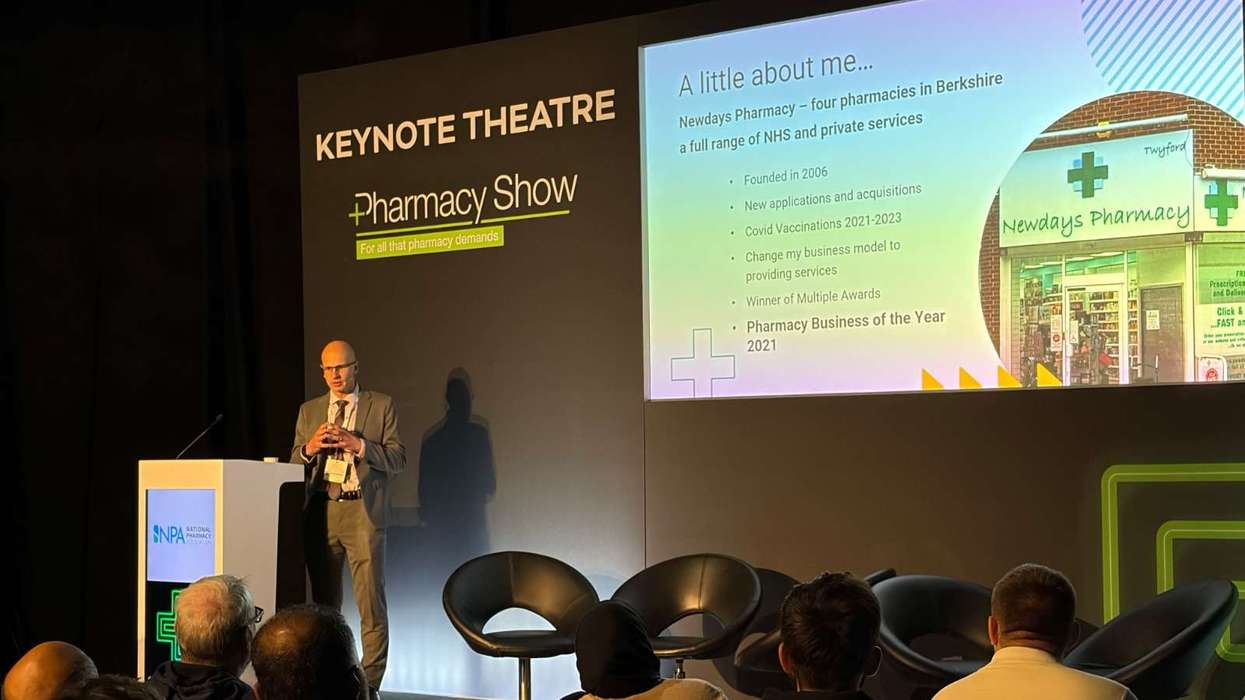

National Pharmacy Association (NPA) chair Olivier Picard plans to support the independent prescribers in his business through training and specialisation over the next six to 12 months, so the team is ready when the funding for NHS prescribing services “is right”.
Speaking at the Pharmacy Show, Picard, who owns four pharmacies in Berkshire and is himself an independent prescriber, said he was not sure that the funding for the new community pharmacy prescribing service would currently be enough for every pharmacy to deliver.
“I’m not a believer that we should be delivering services at a loss,” he said. “What I won’t do is wait for the money to be resolved and start thinking about independent prescribing.”
His advice to delegates was the same: do the training, become a specialist, build the pathway, and engage when the funding works.
Though, with a possible change of government in two or three years, he added, pharmacy cannot assume the current policy direction will last.
His caution is rooted in his own figures. One of his branches, which he describes as average, loses around £51,000 a year once the full cost of delivering NHS services is counted.
The numbers behind pharmacy losses
He explained that one of his own pharmacies, a branch he describes as average, was losing around £51,000 a year once the full cost of delivering NHS services was counted.
Contractors facing figures like these have a choice, he said: "You can go and see the people like Christie & Co and say I've got a pharmacy to sell, or you can try and adapt your business model."
Picard chose to adapt, and he believes independent prescribing is the way forward, but only if pharmacists stop treating the prescription as the product.
The branch dispenses around 7,500 items a month. Picard told delegates it earned roughly £69,000 a year in drug margin, about 12%.
He then added fees and service income, including a busy flu and vaccination season. Against that he set the staff cost of delivering NHS services. Assuming 90% of his team's time went on NHS work, that came to around £222,000.
On that basis alone, the branch appeared to turn a small profit. Picard recalled thinking: "Excellent! I've made a profit. What I had forgotten is I have got my business rates to pay. I have got my rent to pay," he said. Once those overheads were added, the pharmacy was around £51,000 in the red. Even after adding further service income, it was still losing about £10,000.”
"It's not the business model"
Picard qualified as an independent prescriber “early on”, he said.
With prescribing now being embedded in community pharmacy, he said the profession has a second chance to develop this, but the qualification alone does not make a business.
"IP is the qualification. It's not the business model," he said. "I'm an independent prescriber. Now, what I need is a pathway. I need the services."
He urged delegates to build a pathway around the patient: access, history, examination, a decision to treat, refer or advise, the right supply, then review and follow-up.
"Writing the prescription is what happens at the end," he said. One patient told him what she valued most was "the fact that I'm being asked to come back".
He pointed to the NHS England Independent Prescribing in Community Pharmacy Pathfinder Programme as proof the model works. Around 164 sites carried out some 33,000 consultations, and around 97% were resolved without another clinician. Only a minority of consultations led to a medicine being started, stopped or changed.
Survey data backed this up, he said. In research carried out between April and June 2024, 84% of pharmacists said prescribing would speed up patient access; 70% of patients said they were happy for a pharmacist to prescribe, and 64% of commissioners and other professionals were supportive.
When the national Pathfinder programme ended, some of the loudest objections came from GPs who had valued the support, he suggested.
Valued at £200 an hour
Picard said community pharmacists must put a proper value on their time. "My wife is a solicitor. Her charge-out rate is £400 an hour," he told delegates. But, he said: "Trust me when I tell you, she doesn't bring home £400 an hour." The rate has to cover her firm's costs, and pharmacy needs to think the same way.
He prices his own consultation time at around £200 an hour. "If I continue saying that my charge-out rate is, I don't know, £15 or £17 an hour, I'm never going to make a living out of it," he said. "I've got bills to pay."
Pharmacy businesses should count all the revenue a consultation brings, including treatment, advice and related sales, and all its costs, such as prescribing software, clinical notes systems and governance. They should also fill the consultation room's capacity before launching new services, he advised.
His pharmacy teams handle triage, bookings, administration and recalls, so the prescriber's time goes on clinical decisions.
"Don't wait for the money"
On the new national Pharmacy First prescribing pathways for England, Picard discussed the initial payment of around £500 followed by about £525 a month, that pharmacies will receive for prescribing across up to five conditions. As a business owner, he said, he was not sure the funding would be sufficient to allow every pharmacy to deliver it.
Challenged from the floor about whether pharmacists should hold back until funding improves, he said: "I'm not a believer that we should be delivering services at a loss. "What I won't do is wait for the money to be resolved and start thinking about independent prescribing," he said.
In one example, Picard described how ear care has become a cornerstone of his practice. As a prescriber, he can treat external ear conditions himself rather than sending patients back to their GP. He even recalled removing a live insect from a patient’s ear with suction late one Friday afternoon. Grateful patients’ five-star Google reviews, he said, now do his marketing for him.
His second example involved a woman seeking help with weight loss. A fuller consultation revealed she was perimenopausal. Rather than focusing on weight alone, he prescribed HRT alongside weight management support. He contrasted this with online services where “the medication comes in the post,” arguing that patients who receive a proper pathway are the ones who return.
He explained how prescribing transformed his travel vaccination clinic into a full travel health service. He can now prescribe treatments such as altitude sickness medication rather than simply giving jabs.
In each case, his message was the same: build the service around the patient’s need and treat the prescription as just one step in that pathway.
"Profit without governance is a liability"
Picard warned that growth must not come at the expense of safety. Prescribers need the right resources, competence, safety-netting and a system that records every consultation and decision.
He reminded delegates of recent GPhC action against an online pharmacy that had supplied weight-loss medicines without proper clinical governance. The decision to prescribe, he said, should rest on a sound process, not simply on the fact that a pharmacist is able to.
The NPA has published a UK-wide framework for taking independent prescribing forward safely and sustainably. A few weeks ago, it also launched an independent prescribing programme, included in membership.
The programme is aimed at newly qualified and experienced prescribers, as well as superintendents supporting prescribing teams. It covers competence, consultation skills, prescribing governance, templates, and how to market and grow a service. Clinical modules and communities of practice are to follow, Picard said.
NPA members who complete the programme will receive 20% off independent prescribing indemnity insurance.