






AAH Pharmaceuticals managing director Brian Chambers has said that pharmacy underfunding has far-reaching consequences, from wholesaling and pricing to implementation of the government's 10-year health plan. He also said that the current medicine procurement model has made the supply chain unsustainable.
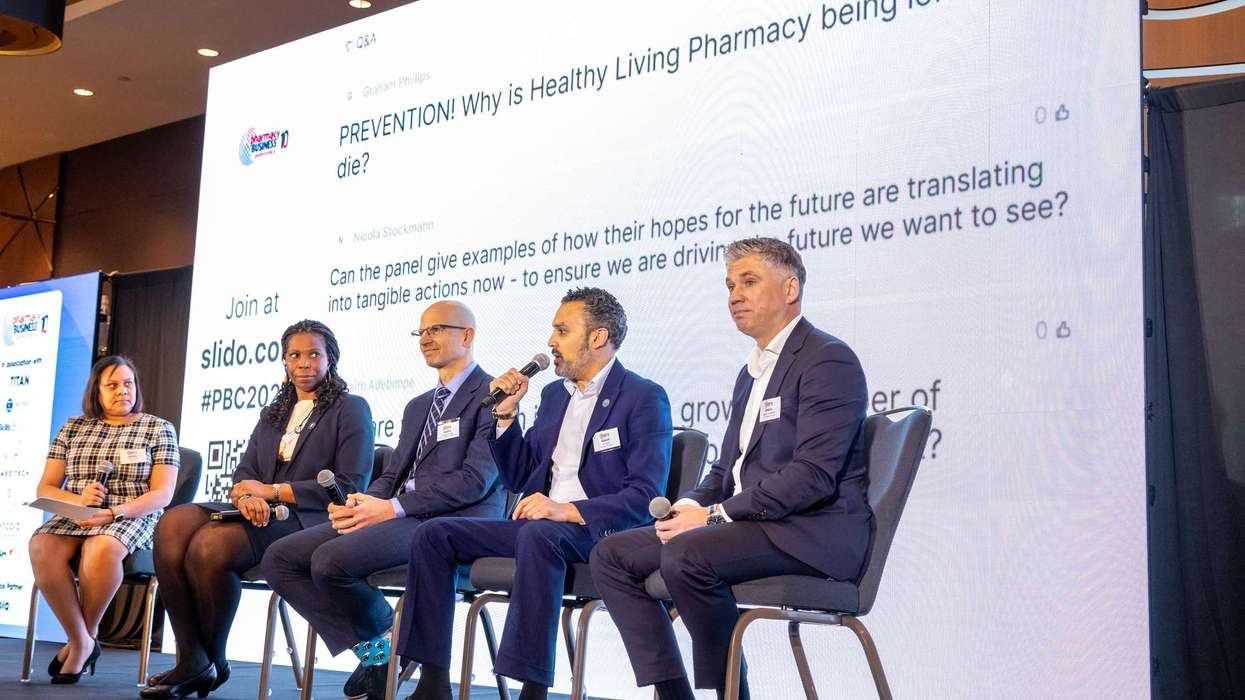
While taking part in a discussion "Leaders Panel – reflections and hopes for the future" during the recent Pharmacy Business Conference, he said pharmacy underfunding is the "crux of everything".
"If the NHS is serious and wants to achieve its ambitions in the 10-year plan, then it needs pharmacy to deliver more services."
Referring to the ongoing CPCF talks, Chambers said he hopes there will be a 'step change' towards pharmacy being paid more money for delivering services.
"Or a reduction in the ratio between the revenue that's generated from services and from dispensing." He, however, ruled out a "leap" in funding.
While initiating the panel discussion, Shilpa Shah, CEO, Community Pharmacy North East London, had asked the panellists, "The community pharmacy contract negotiations are ongoing. What outcome do you anticipate from these discussions? And what can community pharmacies do if the increase in funding is below expectations?"
National Pharmacy Association chair Olivier Picard recalled that 12 months ago, he was part of the Community Pharmacy England committee that was taking part in the discussion with the government.
"We were told by NHS England and the Department of Health last year that this was the first step in the right direction. Now they found all sorts of excuses as to why that's not possible. In my opinion, that is not acceptable.
"The second thing we need to remember is that we all chip in to Community Pharmacy England to go and get a contract for us that is going to deliver."
He said going from his last year's experience, he said CPE's transparency is "perhaps not what it should be", though he conceded that they need to maintain some confidentiality.
Picard said NPA has been pressing for a sustainability payment, without which it will be difficult to survive.
Regarding future preparation, he said the NPA wants to put in place systems that can help pharmacies change and adapt.
"So I'd like to think that my technicians can run my dispensary, and for that, I might need to change my computer system. I need to have a sustainability of drugs coming into the pharmacy, so I don't spend my time trying to chase pennies or trying to order that because actually my focus should be on services."
He said the government should bridge the gap so that it allows pharmacies to deliver services and invest in them.
Jay Patel, executive director, Day Lewis, said he would like to see the reduction of the funding gap, but was also mindful of the government's tight financial position.
In terms of what pharmacies could do, he said they cannot continue to offer services as in the past. They need to be realistic and rationalise their offerings.
The newly-appointed president of Royal College of Pharmacy, Tase Opotu, said the change from the Royal Pharmaceutical Society to the Royal College of Pharmacy is a "step change in how we want to operate and how we are viewed across the landscape of healthcare, the government, and all of our pharmacy stakeholders."
She said the Royal College can be a stronger voice "in those rooms where discussions about funding are being held."
Supply chain challenges
Regarding the current supply chain challenges, Chambers said it is fundamentally broken and does not work.
The government wants the pharmacies to consistently chase the lowest possible price every single day, and now software to compare prices is being used for the purpose.
The prices have fallen to record levels, and Chambers said he agreed with what his friend Rajiv Shah posted recently on LinkedIn, "The genetic market in the UK is a basket case."
"If I told you that I was selling generics on average 40 percent less than I was two or three years ago, would you believe me?
"And would you wonder where that value has gone? Because if you're doing such a great job of buying that I'm selling generics that much cheaper than I was, then you must be making loads more money.
"But you're not, because the value's been extracted out of the system."
Referring to price concession list, which is now at a record high, he said it is because the medicine exists, the supply chain and distribution network is there, "but this country has forced pricing to be so low that those products are now uneconomic to exist in the UK."
And the prime reason for this situation is how the pharmacies procure their regular supply of medicines.
"At the grassroots level, the product jumps about from supplier A to supplier B to supplier C to supplier D based on a penny difference every single day.
"We don't know what to put where because we don't know what we're going to have. The core point is we cannot have a resilient medicine supply chain without predictability, and we do not have predictability."
"Generic manufacturers do not know what I'm going to buy from them month to month, because I don't know what I'm going to sell month to month, and I don't know what stock to put where week to week anymore."
Chambers asserted that a resilient medicine supply chain is not possible under the present circumstances, as it is not at all sustainable.
He said the issue is too serious and we need to have real "serious grown-up conversations" and join up wholesalers, contractors, manufacturers, and help the government understand the consequences.
Chambers claimed that over 50 percent of the generics that they sell are under 50 pence.
"And that's millions of packs every week under fifty pence. The variable cost to sell is more than the profit on those packs. We make a couple of pence margin. The variable cost to serve is higher.
"What that means is, we might as well not sell the stuff and take the cost in and make the business more profitable. Now, clearly, that's not a decision that we would make, but that's the consequence that we collectively need to help the government understand.
"What are the decisions that we will need to make as a result of the economics of this current system. And if we join up community pharmacy, what are the consequences within pharmacy? What are the consequences within wholesaling? What's the consequences within generic manufacturing?
"If we join up the dots, we've got a much more compelling list of reasons for why we need to fix this system."
Chambers said predictability is also crucial, as it helps wholesalers manage the supply chain better, and have enough money to invest in the network.
It can only happen if you have predictability, and make enough margin. "If you're selling more than fifty percent of your net for less than fifty pence, then the system is just not working."
Patel concurred with Chambers' views on unsustainable drug prices and called for reset.
"I think we need to shift rapidly to a contract model with the government where there is some form of benefit sharing, where our goal isn't just to hammer the supply chain to make it cheaper and cheaper," he said.
Oputu remarked that the price that we're paying for pure drugs is very cheap. "In the face of that, the cost to move that product, to hold that product, to store it, has gone up.
"This stuff has to be temperature-controlled from source right the way through to when it lands, uh, in your pharmacy. It, it's an economic issue. There just isn't enough funding."
The government only considers the manufacturing costs. "No one's factoring in the cost to move it, to ship it, to store it," she said.
"There needs to be a win-win relationship between how we work and, and our paymaster, the government. At the moment, pharmacies are losing, and the government is winning. That's unsustainable," she added.