





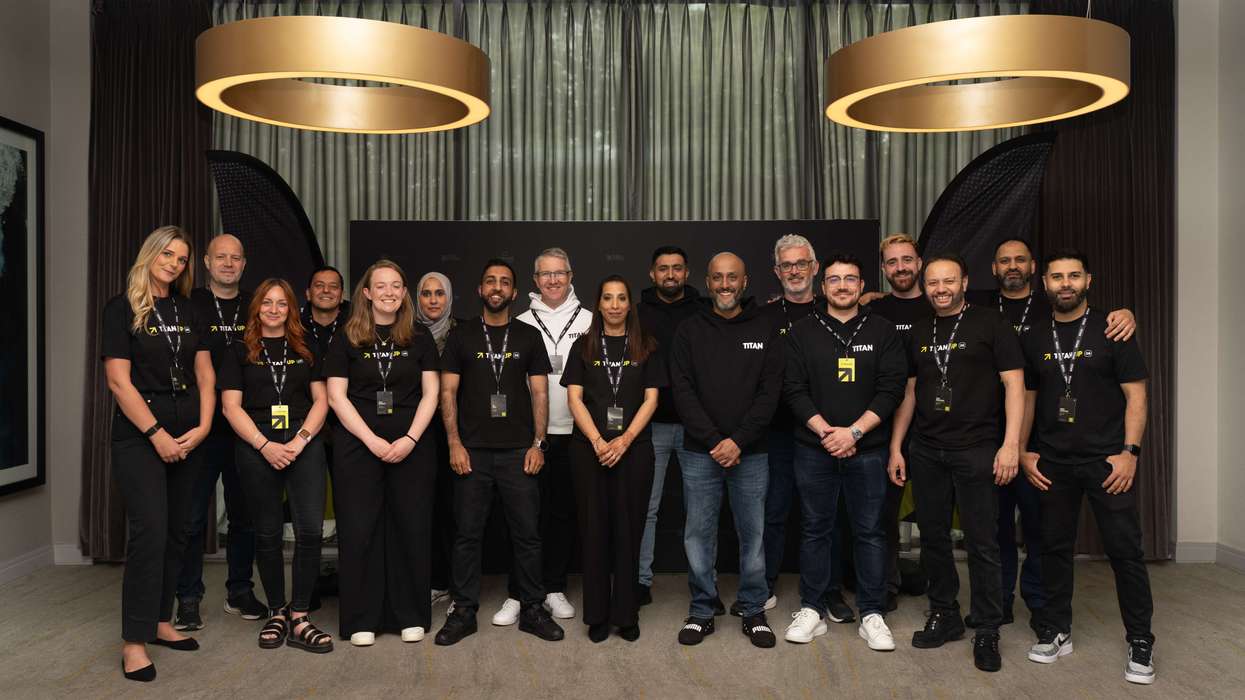

Titan will commit a further £1 million to reinvestment in AI development this year, delegates heard at a technology event hosted by the company.
TitanUp 26 brought together Titan PMR users, clinical speakers, technology partners, exhibitors and pharmacy business owners to discuss how community pharmacies can use technology, automation and services to build a more sustainable operating model and improve business efficiency.
The company announced new products and features to support pharmacy businesses, alongside significant investments in the field of AI to increase efficiencies, and advancements in the development of Titanverse and the “everything platform”.
Facing business realities
Tariq Muhammad, chief executive of Invatech Health, the company behind Titan PMR and Titanverse, acknowledged the challenges pharmacy businesses were facing.
Tariq reflected on his own struggles in the past around building a pharmacy business which was entirely dependent on the NHS, and encouraged contractors to take steps to stabilise their businesses.
“The primary objective has to be making sure that you are financially sound. When you make money, you can help your patients, you can create new services, you can help your staff – give pay rises, give career progressions. You can buy more pharmacies and you can invest in those pharmacies.”
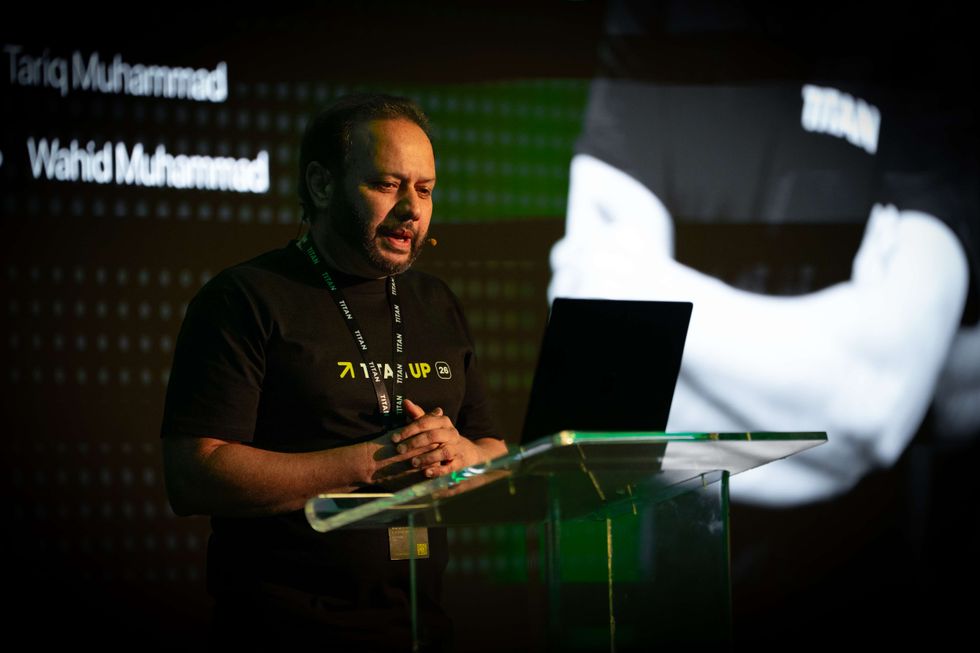 Tariq MuhammadTitan
He talked to delegates about “the P word”, which he went on to explain meant “Profit”.
“Wanting profit doesn’t make you greedy,” he told delegates. “Wanting profit does not make you selfish. Wanting profit is simply admitting the reality of being in business.”
“You see, profit isn’t the opposite of care. Profit is what makes care possible,” he said.
Tariq described the barriers that prevent success, but are within the control of businesses, and can be ingrained habits.
He described three habits to be broken: dependency on the NHS, giving services for free, and not using data. He then shared three new habits to be formed: working on your circle of control, streamlining operations, and developing new income streams.
Tariq announced a development roadmap and new features designed to support pharmacy businesses. “From today, Titan no longer means PMR,” he said. “From today, Titan means business.”
“We are committing a further £1 million to AI development because clinical AI in pharmacy has to be built properly. That means investing in our own models, our own infrastructure and the clinical governance behind it,” he said.
The themes were reinforced by Michael Holden, managing director of MH Associates, who told delegates that profit also required planning.
“It’s about profit, but I’m going to introduce another P word in a minute. It’s ‘plan’, because without a plan and some measures in that plan, how do you know you’re succeeding?”
Holden’s point brought the discussion back to execution: ambition only matters if owners can turn it into a measurable plan.
Rahul Puri also spoke as a customer case study. His session focused on patient intent and the need for pharmacies to build longer term patient journeys rather than isolated transactions.
“Today I’m not going to talk to you about Pharmacy First,” he said. “I’m not going to talk to you about flu vaccinations and I’m also not going to give you a list of 10 services that you have to roll out tomorrow, but instead I want to share a playbook that completely changed the way that I understood how pharmacy should grow.”
He argued that activity alone does not create a sustainable pharmacy business.
“Activity and profit are not the same thing,” said Puri. “Being busy and creating value are very different things. Being busy is not a business model. I believe it’s a symptom.”
He said he believes that opportunity lies in understanding why patients come to the pharmacy.
“I believe the future of pharmacy revenue is patient intent,” he said.
“One consultation with a patient creates revenue, but a patient journey is business.”
Rhys Lloyd, co-founder of PharmAppy, said that customer expectations are high, and that promoting patient access is crucial.
“Pharmacy has entered a consumer world,” he said.
“Patients are no longer comparing you to the pharmacy down the road, they’re comparing your experience to everything else in their lives, Amazon, Uber, banking apps, food delivery, social media, that’s the benchmark now.”
He said pharmacy websites and apps now form part of how patients judge whether a service feels modern, accessible and trustworthy.
“Your website is now your digital front door,” he said.
Ghulam Haydar, from Allied Health Training and a former GPhC clinical advisor and specialist inspector, focused on governance.
“When you develop private services, it comes with a great level of responsibility,” he said.
He told delegates that private services require owners and superintendents to think carefully about pathways, risk assessments, training records, consultation notes, audit trails and regulatory compliance.
“If it’s not recorded, it didn’t happen,” he said.
Technology announcements
Wahid Muhammad, chief technology officer at Titan, set out the company’s latest work on artificial intelligence.
“We don’t use AI,” he said. “We build AI.”
He explained that Titan had built its own models and infrastructure, supported by AI specialists and an internal clinical team of pharmacists and clinicians, and that the company was aligning its work with MHRA medical device requirements and external governance.
Referring to the use of generic AI tools, he said: “That’s not good enough when it comes to health tech; it’s not good enough when it comes to clinical systems.”
Titan announced Level Five Titan AI, which Wahid described as a ‘ground up’ development of its clinical checking automation predicted to manage up to 90 percent of clinical checks, freeing up significant pharmacist time.
"Your AI is only as good as the data that you train it on," Wahid said.
He told delegates that Level Five was the product of a rebuilt internal AI team led by Professor Mohamed Bilal, a professor of AI, supported by additional PhD-qualified engineers and an internal clinical team of pharmacists training the models ‘on hundreds of thousands of rows of dispensing data’.
"Titanverse is your business platform. It's your finance platform," he said.
Wahid set out a wider repositioning of Titanverse, from a private services platform to a complete business and finance platform for independent pharmacies. New features inside Titanverse are aimed at the areas where pharmacy income is most often lost, including a concession management system, an integrated claims process to flag missing endorsements before submission, and a live view of expiring stock.
"Smoke and mirrors is blurred," he said, referring to the visibility independent pharmacies have today over their revenue and cost of goods. "We're here to stop that."
The new tools include live gross profit visibility, built directly into Titanverse following work with the NHS Business Services Authority to reverse-engineer the FP34 pricing engine.
"This truly is your business in your pocket," Wahid said.
A mobile version of Titanverse was also announced, available on iOS and Android, with customisable KPI dashboards, prescription clinical checking, live finance summaries, integrated messaging across teams, and a consultation extension for private services.
Other announcements included a new stock management system with cross-branch transfer visibility, a redesigned dispensary board, a one-click MDS process for tray management, and Titan's own integrated CD Register.
New approaches
Alongside keynote speeches and product updates, the day included live demonstrations, customer interviews, exhibitors, networking, a dedicated event app, and a humanoid robot interviewing guests.
By starting conversations, the robot conducted impromptu interviews with sponsors, attendees and speakers.
"It's the best TitanUp event I've attended so far. This is a whole different ball game," said Tas Bhatti, a founding member of the IPCN independent contractors' network.
"It's been a massive game changer for us. We're saving hours," said Pritpal Grewal, who runs Balance Pharmacy and operates a BD Rowa robot integrated with Titan. "Work that used to finish at 5pm or 6pm is done by about 1pm now."
"I'm completely out of the dispensary. Simple as that," said Malesh, of Hayden Pharmacy, six months into using Titan. "Now I'm in the consultation with the patients, so I can generate some income."
With more than 1,500 community pharmacies on the platform, a £1 million reinvestment programme in AI, and a customer base that its founder himself describes as a movement, the company says it intends to move to occupy a different role, as “the operating infrastructure for the next decade of independent community pharmacy”.
Presenting Titan as no longer ‘a PMR provider competing on features’, Tariq said to customers: “You did not just buy a system. You joined something.”