






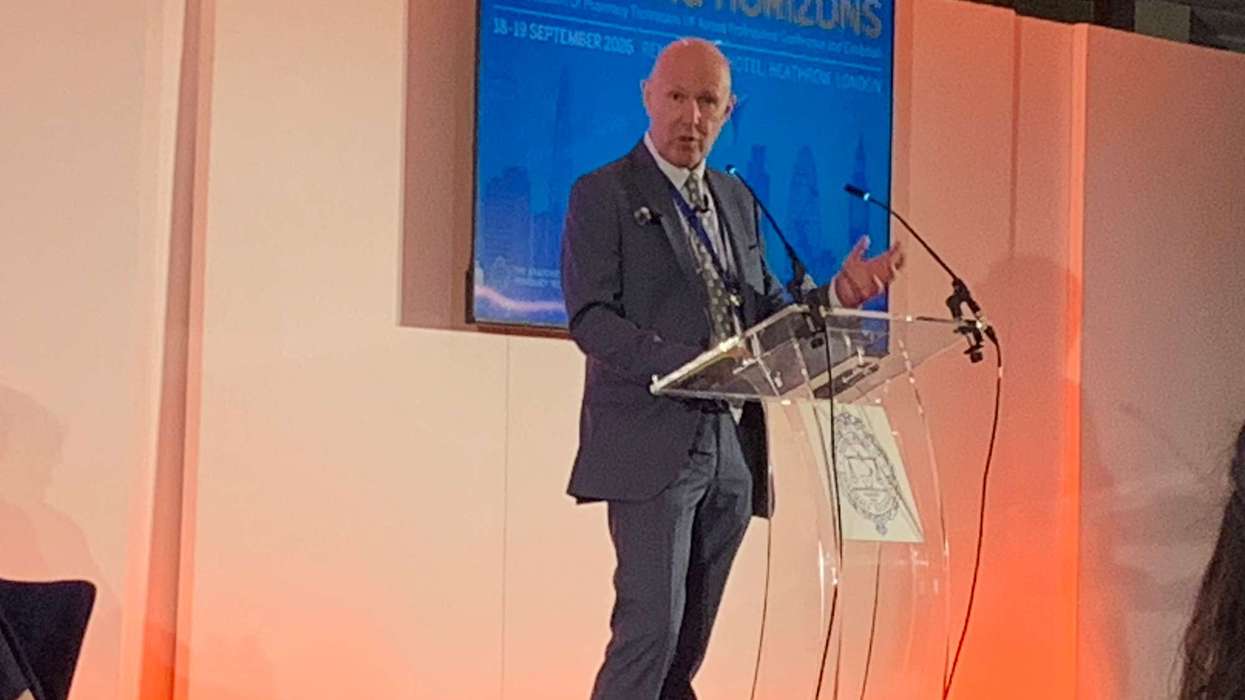
Caption: David Webb, Professor Kathy Harrison, and Kathy Cashell addressed delegates at the APTUK Annual Professional Conference 2026.
NHS England’s Chief Pharmaceutical Officer David Webb said that the pharmacy technician profession is undergoing a “renaissance in practice,” moving far beyond traditional technical functions into leadership, quality improvement, service development, and clinical support across theatres, discharge processes, and elective recovery.
He was speaking at the APTUK Annual Professional Conference 2026, 'Expanding Horizons', held on 18 and 19 September at Heathrow, London.
Pointing toward the legal changes around supervision due to take effect on 10 December, alongside expanding practice via Patient Group Directions (PGDs) in areas such as vaccinations, Webb maintained that the future relies on career development pathways that unlock professional capability across every setting.
“Pharmacy technicians are no longer defined by where you work. You're defined by the professional contribution you make. The future requires you to be confident, highly autonomous, clinically capable people – leading improvement, influencing systems, and delivering better outcomes for patients across every care setting.”
Welcoming delegates to the conference, Amy Laflin of APTUK, echoed the statement.
“As I look across the room, I see a profession that’s changed enormously over the past decade. The pharmacy technician role has evolved from one that is primarily associated with technical accuracy and medicine supply to one that’s now recognised as a critical clinical and professional role within healthcare systems across the whole of the UK.”
Referring to the recent findings of the Thirlwall inquiry, Webb urged the profession to keep patient outcomes at the forefront of change:
“Events this week have caused us all to really reflect on quality and what that means for patients and the public. By quality, we mean safety, clinical effectiveness, and patient experience.
“The lessons of all the inquiries that have happened – and Lady Thirlwall's this week in particular – is to remember that at the end of each process and at the end of each development is a patient,” he said.
Developments in Northern Ireland
In her address, Professor Kathy Harrison, Chief Pharmaceutical Officer for Northern Ireland, provided an update from Northern Ireland, and confirmed a major shift in the route toward statutory regulation for pharmacy technicians in the region.
She said the work to regulate the profession had been progressing under the Pharmacy Technician Regulation and Development Project, established in 2023 following the 2020 Pharmacy Workforce Review. The plan is to introduce statutory regulation via the Pharmaceutical Society of Northern Ireland (PSNI) by April 2027.
However, Harrison confirmed that the PSNI has had to pause its involvement due to wider institutional sustainability challenges, prompting the Department of Health to launch a wider consultation this autumn.
“The department will now consult on the future of regulation for the whole pharmacy profession in Northern Ireland, encompassing options for both pharmacists and pharmacy technicians. We plan to publish that consultation this autumn.”
The upcoming consultation will clarify whether future statutory regulation will sit with the PSNI or transition to the GPhC. While expressing personal disappointment over the timetable disruption, Harrison underlined that focus on workforce development, education, and career frameworks continues.
“Although we are not in the place that we had planned to be, and we've been working so hard to get to – and even though we had, I think, an end within our reach – I am personally very disappointed, both for myself and for pharmacy technicians across Northern Ireland.
“We remain absolutely determined and fully committed to delivering regulation, advancing education and training, and supporting career progression for all of our pharmacy technicians in Northern Ireland in the future.”
GPhC’s new standards
During her address to the conference, GPhC Chief Executive Kathy Cashell outlined the regulator’s forward-looking agenda, reaffirming that protecting the public and empowering professionals go hand in hand.
Cashell highlighted that newly-published Initial Education and Training (IET) standards for pharmacy technicians reflect the growing complexity of the sector, giving incoming professionals the clinical, technical, and leadership grounding needed to support medicine supply, preparation, and clinical services safely.
She also detailed the next steps in the GPhC’s multi-year regulatory review:
Responsible Pharmacist and Superintendent Pharmacist Standards: The regulator will introduce dedicated standards to ensure legal changes across supervision and medicines supply are safely implemented, establishing transparent governance and clear boundaries between professional roles.
Core Standards Review: The GPhC will next year initiate a formal review of its core standards for pharmacists, pharmacy technicians, and registered pharmacy premises to ensure requirements mirror modern clinical practice.
Cashell also confirmed changes to the GPhC’s 14-member governing Council. Following the conclusion of current pharmacy technician member Penny May Bishop’s term, two pharmacy technicians will join the Council next year: Liz Fidler and Claire Dearden.
“Standards really do matter. They're not just regulatory documents – if we do them well, they help define professional expectations, shape the cultures within organisations, and really influence how care is delivered to patients every day,” Cashell concluded.
She urged the pharmacy technicians to respond to GPhC’s consultations, because “effective regulation can only be created through dialogue with the professions that we regulate and the people that use your services.”