






Key Summary
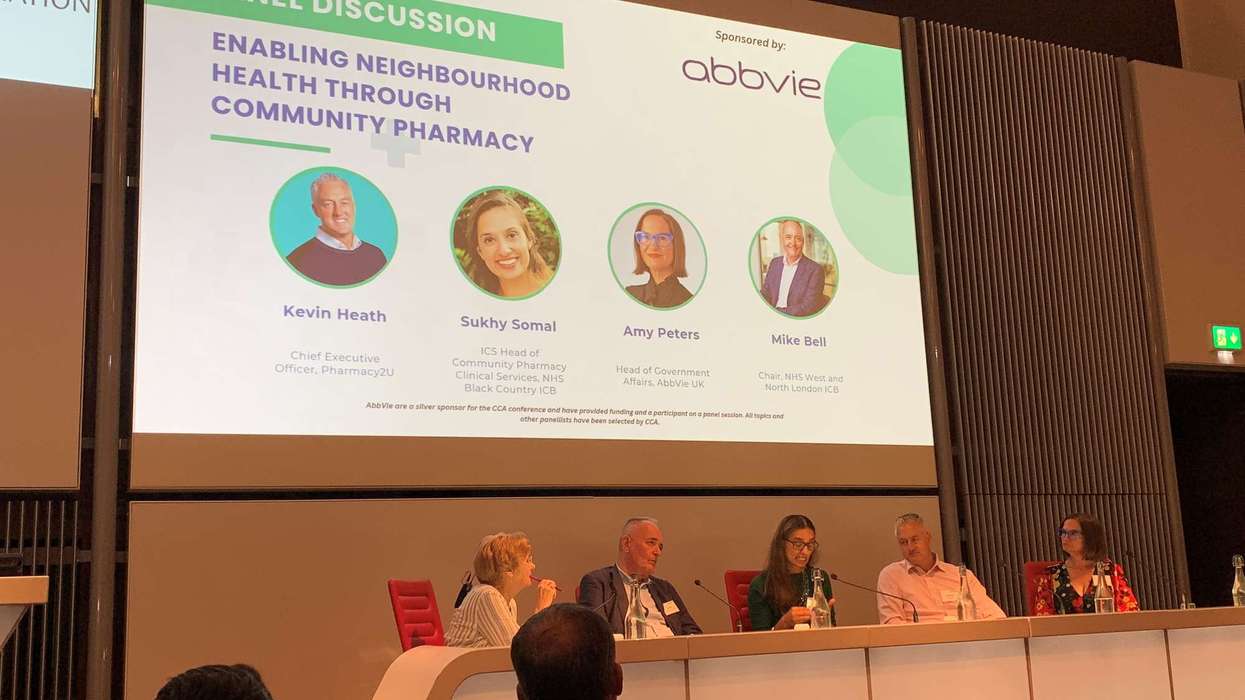
- The CCA hosted a panel discussion on "Enabling neighbourhood health through community pharmacy".
- It was chaired by Dame Barbara Hakin and included two ICB representatives who are successfully involving community pharmacy in neighbourhood working
- Discussion included the ‘how’ of shifting more care out of hospitals and into primary care, as part of the 10 Year Health Plan.
Community pharmacy has a huge amount to offer neighbourhood working, but needs to be at the table to ensure they are fully integrated into new ways of working, delegates at the Company Chemists' Association (CCA) policy conference heard this week.
A panel discussing "Enabling neighbourhood health through community pharmacy" was chaired by Dame Barbara Hakin and featuring key industry leaders.
Suky Somal, Head of Community Pharmacy and Integration at NHS Black Country ICB, clustered with NHS Birmingham and Solihull, detailed the cultural and operational opportunities in integrating community pharmacies into the NHS's new localised neighbourhood models.
Speaking at the conference on Tuesday (30 June), Somal highlighted that local care teams can misunderstand the capabilities of pharmacists, requiring targeted internal communication.
“Don’t ever assume that colleagues in those neighbourhoods actually understand what community pharmacists do,” she warned.
Her ICB has co-funded dedicated pharmacy leads across all 28 Integrated Neighbourhood Teams (INTs) to share local information, eliminate duplicate work, map pharmacies into wider estates management plans, and launch point-of-care preventative health hubs in highly deprived areas to safely divert pressure away from general practices.
"We had a little sit-down and said jointly, how could we, as the ICB and the LPC, work together to really put community pharmacy at the forefront. We actually agreed to have a pound-for-pound match fund to get workforce that would actually sit in on every INT meeting,” she added.
Somal also focused on the operational reality of inequality. She highlighted that the most vulnerable patients can often avoid traditional primary care entirely, which means clinical teams must actively deploy preventative care directly in community. Several initiatives have been launched by the ICB to bring care closer to them, such as point of care testing.
Michael Bell, Chair, NHS West and North London ICB, focused on the deployment, strategy, and socio-economic vision backing the integration of pharmacies into neighbourhood planning in London’s largest ICB.
"My ICB has committed to spend, over the next three years, a minimum of £360 million on the shift into neighbourhoods, an unprecedented amount of investment going into a neighbourhood health programme, which definitely includes pharmacists. This isn't special project funding, this is a shift in ongoing revenue to really, really significant."
"We are absolutely committed to our 50 neighbourhoods in the patch, wherever possible, placing our neighbourhood health centres on the high street. We think that we have a commitment as the NHS to drive economic activity, and we know that free health on the high street drives footfall,” he said.
Bell also called out the traditional, reactive model of NHS funding, pointing out that it naturally creates stark health inequalities because GP practices organically cluster in wealthy regions rather than areas of deep social deprivation.
Kevin Heath, CEO, Pharmacy2U, provided a national, digital perspective, emphasising that digital dispensing and remote medication management should not compete with localised infrastructure, but rather absorb routine volume.
He highlighted automated scaling as the key mechanism to unlock local face-to-face capacity for complex clinical interventions.
"Not that local versus national, but actually, how we can work together in order to do the heavy lifting for only the services that can be done face to face in a pharmacy. What a national digital provider can do can lift the stability from the scale, ready for face-to-face conversations that need to be had out there in the community."
Amit Patel from Community Pharmacy South West London questioned how independent pharmacy contractors can ensure their role in the co-design of neighbourhood services, to ideally automatically be at the table locally and ‘be part of the infrastructure’.
In response, Somal, said that showing what community pharmacy can do is the solution.
“I do find you’ve got to elbow your way to the table and have a louder voice from community pharmacy from other colleagues in primary care. For me that’s about understanding what we are trying to achieve. What’s the ICB trying to achieve, what are we trying to solve. And then from the community pharmacy perspective, what have you got to offer. Some of the funding proposals that we’ve got in neighbourhood working have happened because of the listening exercise – what’s the problem we need to fix, who do we need to speak to who is holding that purse-string, who can release that money.”
Heath said that pharmacy will benefit from focusing on a unified mission: “I'll just talk briefly on how to play to win rather than or losing. I think the mission is really clear and simple. Everybody in this room has patients at the heart of everything they want to do. They are trying to improve health outcomes, so let's not forget the mission. So, just showing what can be done is how you will be successful.”
Amy Peters, Head of Government Affairs, AbbVie UK, emphasised that AbbVie is also in "learning mode" as the 10-year health plan pushes care out of traditional hospital settings – where most of AbbVie’s core portfolios currently sit – into community pharmacy hubs.
Peters highlighted that community pharmacies are central to neighborhood health.
She referenced a recent CCA report showing that out of 2.5 million annual GP consultations for headaches, up to half (1.25 million acute cases) could be safely managed by highly accessible and trusted community pharmacists.
“We also know that 80% of the public actually trust their pharmacist to tell them the truth, and you will all have private rooms where you can actually take a person back in and have a really good chat with them as well. So it’s a combination of all those things.”
The panel discussion was followed by concluding remarks from Malcolm Harrison, Chief Executive of the Company Chemists’ Association, saying that discussions at the event “continued to reaffirm the value of community pharmacy and the criticality of continued investment and enabling policy to ensure the sector can deliver more for patients.”