







Key Summary
- Janet Morrison, CPE, says if deploying independent prescribers for NHS services is not rewarding, pharmacy owners should consider them for private services.
- NPA chair, Olivier Picard, said that contractors have been raising concerns, and wondered how pharmacists could do a consultation for £17.
- Reena Barai of SG Barai Pharmacy, fears that community pharmacies may lose out the newly qualified independent prescribers to GPs.
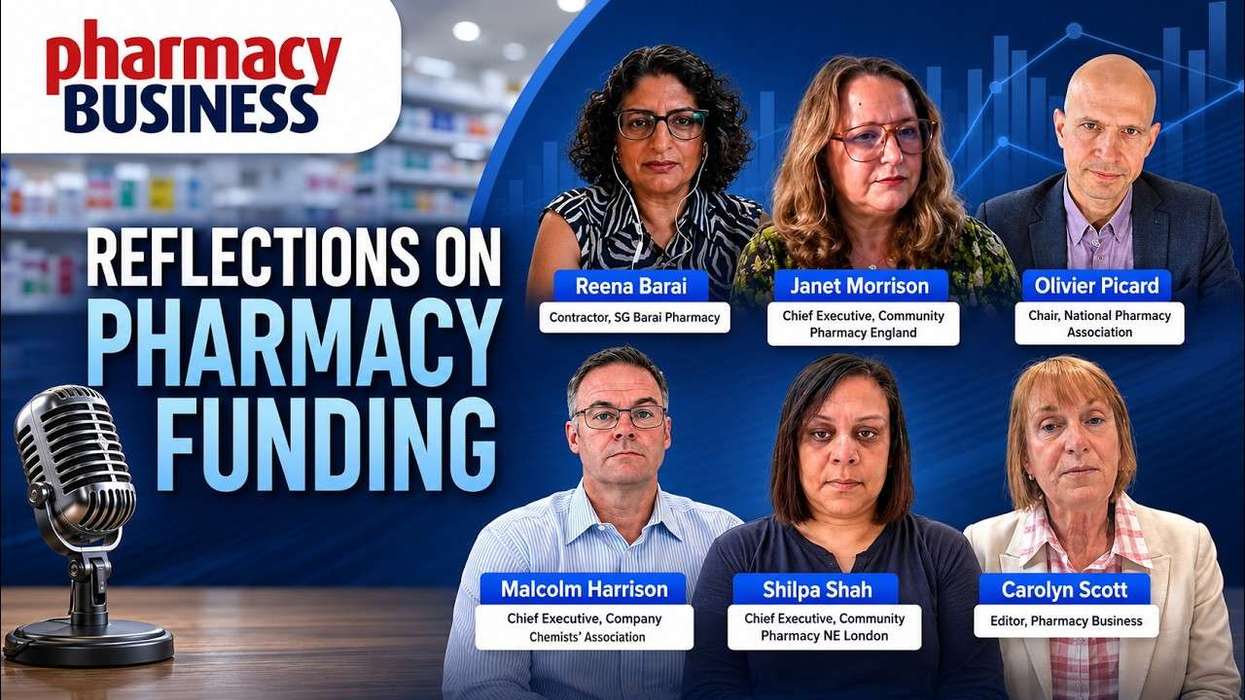
Community Pharmacy England (CPE) chief executive Janet Morrison has cautioned contractors to carefully consider cost benefits before engaging with the Independent Prescribing (IP) service.
In a Pharmacy Business panel discussion, "Reflections on Pharmacy Funding", she said during the Community Pharmacy Contractual Framework (CPCF) negotiations, they had told the government that this was an "insufficient investment".
“It doesn't cover the true costs of implementing the governance, the clinical care, the infrastructure, the digital requirements and the amount of time and workload it will take, so I'd say consider that carefully,” she said.
Morrison said independent prescribing is strategically important for future direction and clinical services.
"But if it's insufficiently funded or it's not going to be worth it for contractors at the moment, then I think we should continue to deploy independent prescribers in private services as part of that strategy for diversification."
Independent prescribing will be introduced into the CPCF as an extension of Pharmacy First and the Pharmacy Contraception Service (PCS) from the autumn of 2026.
She added that the new pharmacy graduates who will also be independent prescribers will need an enormous amount of support.
"They're not going to be there and off and running, and that does create challenges for businesses in terms of being able to support them properly."
During the podcast, the NPA chair, Olivier Picard, said that contractors have been raising concerns regarding independent prescribing, and they are worried about the economics.
He wondered whether pharmacists could do a consultation for £17, and observed, "It costs me more to employ an independent prescriber."
Shortage of DPPs
Community Pharmacy North East London CEO Shilpa Shah said the contractors are happy that independent prescribing is on the contract, but they're disappointed with the remuneration.
Some feel that it's no different from some of the work they were already doing.
She also wondered what it means to people who aren't independent prescribers. "Are we going to create a two-tier system?"
Shah, however, encouraged community pharmacists to acquire an IP qualification if possible. She said that though training slots are available in some places, there are not enough Designated Prescribing Practitioners (DPP).
She said her organisation has managed to get a group of general practitioners who want to be DPPs, and pharmacies can access this for a nominal fee.
"We don't want to do things for free, and other healthcare professionals also don't want to do things for free," she said.
Regarding independent prescribers who will be qualifying this year, she said pharmacy owners need to embrace portfolio careers.
Pharmacists may be allowed to work a couple of days in a GP practice, a couple of days in secondary care, and a few days in community pharmacy. This will help pharmacists enhance their skill set, and it will be beneficial for community pharmacies, she added.
Low returns are a barrier
Reena Barai, who owns S.G. Barai Pharmacy, said she has been a passionate advocate of IP, particularly as a prescribing pathfinder site, but now the funding issue may prove to be an obstacle.
"While I really welcomed the IP news in the new contract, the funding is creating a dilemma for me. I really want to deliver it and I can deliver it.
"As part of the Pathfinder programme, I learned so much. I've grown so much as a prescriber. My ability to support patients is elevated, and I want to be able to use this service."
Barai says she is keen to take up the new opportunities, but is also mindful that she should not undersell herself.
"My other concern is we have a whole generation of pharmacists coming out of university, and I've got three trainees with me at the moment who are IPs, and I've been their DPP for the first time."
She says she is keen that the new trainees take up employment in community pharmacies, but is not sure whether they can retain them.
"We are the biggest employer of pharmacists, and if they can't use that skill in our pharmacy, where are they going to go?"
She fears pharmacies will lose out to GPs in employing independent prescribers.
Citing her own example, she said she wants to retain the workforce and wants to use their skills, but there is no money.
Lack of support
Picard said he is an independent prescriber himself and has been its strong advocate, "whether you like it or not, it's coming."
He said there will be a rapid increase in the number of independent prescribers.
"But, there is a note of caution. Becoming an IP should not simply be viewed as a way of helping pharmacists to deliver more services.
"It must be properly supported, properly governed, and properly funded.
"The workforce challenge isn't training enough prescribers, I think it's creating an environment within our pharmacies where those prescribers can actually use their qualification."
He cited the example of Scotland, where they started having IPs in their pharmacies over two decades ago.
During a recent trip to Edinburgh, he said he learned that only 50 percent of pharmacies in Scotland currently have IP service, and they didn't wait to have 100 percent to launch a service.
Second, Scotland's Pharmacy First service covers 27 conditions, whereas in England it is seven.
He said that in Scotland, when someone walks into a pharmacy and asks for advice, the pharmacy team will decide what is required – whether it is pharmacy first consultation, sale of a product, supply of a prescription-only medicine, or an independent prescriber.
He said this is something England should aim for. "My biggest concern is not the supply of prescribers, it's ensuring that there is enough funding, governance, and infrastructure."
Barriers to growth
Company Chemists' Association chief executive, Malcolm Harrison, said IP is the future and pharmacy organisations have worked hard to create an environment where pharmacists can safely prescribe.
However, he is concerned about the future challenges and risks. He wonders what would happen if "we end up in a situation where we've trained up a load of pharmacists, and they have the qualification ability to prescribe, but there's nothing to prescribe in community pharmacy."
Referring to the CPCF settlement, he said the headline figure is great, but he is concerned that it will not "filter through to the bottom line for businesses".
He felt that not enough has been done to reduce the risks faced by pharmacies. "We're seeing the same level of workload expected from pharmacies, even though there's a recognition from government they can't afford to pay us to do what we're doing."
He said the contractors need to stop doing the stuff they are doing for free.
"You know, you need to invest in physical space within your business, in the training and development, the team, in the operating systems. But how can you do that if you don't know you're going to get a return on that?"
Harrison said it is important to take stock and understand what can be done to reduce the cost of delivering what we have to do currently before we start focusing on future.
Concurring with his views, Morrison said the CPE feels there should be an easing of some regulations to operate effectively.
She said her organisation has put in a host of proposals into the negotiations for contract reform, for funding reform, and for regulatory easements.
"We will be pursuing now, and I do think that I'm not too naive, but I'm meeting with pharmacy minister Stephen Kinnock to set up the programme of work that we need to do," she said.
Morrison said she feels the minister is serious about the issue and discussions with the sector.